
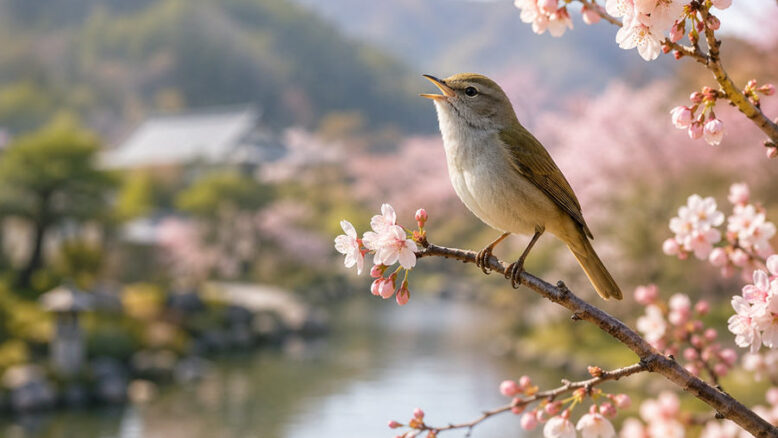
There is no single Japanese kanji for songbird. What Japanese has instead is something richer: specific birds whose songs are woven into classical literature, seasonal poetry, and everyday cultural life — and a precise vocabulary for sound, voice, melody, and resonance that gives naming from this territory its real depth. At the centre of it all is the uguisu, whose first call of spring has been celebrated in Japan for over a thousand years.
The Uguisu — Japan’s Songbird
The uguisu (鶯) — the Japanese bush warbler — is Japan’s defining songbird by a considerable margin. Its call, a rising sequence rendered in Japanese as ho-ho-kekkyō, is one of the most recognised sounds in Japanese nature. The bird’s first song of spring — hatsune (初音, literally “first note”) — is a celebrated seasonal event in classical literature and poetry, the sign that winter has genuinely ended. The uguisu-bari floors at Nijo Castle in Kyoto — boards engineered to chirp softly underfoot as a security measure — were named after the bird’s call. No other bird in Japan has this density of cultural association concentrated specifically in its song.
Uguisu (鶯)
The bush warbler used as a given name. Rare and poetic rather than conventional — most Japanese families would find it unusual as an everyday personal name. But its place in Japanese aesthetic tradition is so deep that the name carries immediate cultural resonance: spring, the arrival of warmth, the first beautiful sound after silence. For a fictional character defined by voice, artistry, or the quality of being the first to announce something important, it holds without needing explanation.
Hatsune (初音)
Means first note or first sound — 初 (first, beginning) and 音 (sound, note). Specifically the name given to the uguisu’s first call of each spring in classical Japanese literature — a moment so anticipated that poets wrote about it for centuries before it arrived. A real given name in Japan, it gained wider modern recognition as the name of a Vocaloid music character, which has made it more familiar to younger audiences without diminishing its classical depth. For a girl or fictional character defined by voice, beginnings, and the quality of being heard first, the name is precise and genuinely beautiful.
Harutsuge (春告)
Drawn from harutsugidori (春告鳥) — the classical poetic name for the uguisu, meaning the bird that announces spring. 春 (spring) and 告 (to announce, to tell). As a standalone given name it is unusual and skews toward creative or fictional use rather than everyday naming. For a character whose defining role is to bring news of something new and good — to be the voice that arrives before the thing itself — the name earns its place precisely because it describes a function rather than simply a sound.
Skylark and Swallow — High Notes and Swift Songs
The uguisu sings from cover — from within dense shrubs, rarely showing itself. The skylark and the swallow sing in the open: one rising until it disappears into the sky, the other skimming low and fast in long chattering runs. Both are sonically distinctive birds with their own place in Japanese tradition.
Hibari (雲雀)
The Japanese word for skylark, written with the kanji compound 雲雀 — read as a unit rather than parsed from its individual characters. The skylark rises singing into the sky until it becomes invisible, its song reaching the ground from a point too high to see. As a name, Hibari carries that quality of voice that travels further than the body behind it — something that ascends and keeps ascending. Most famously the name of the legendary enka singer Hibari Misora, whose voice defined a generation of Japanese popular music and whose name now carries that additional resonance of extraordinary vocal reach.
Tsubame (燕)
The swallow — 燕 — calls in rapid, overlapping bursts while in flight, a quick social chatter that fills spring air. Its voice is not a melody but a presence: constant, quick, and unmistakably alive. As a given name Tsubame carries the swallow’s speed alongside its sound: a name that is light, quick, and present in the way that a swallow passing at low altitude is present — briefly, fully, and gone. A real Japanese feminine name.
Sōkyū (蒼穹)
Means the vast expanse of sky — 蒼 (deep blue, immense) and 穹 (the dome of heaven, the sky’s vault). A literary and poetic word rather than a common given name, but in the context of singing birds it names something specific: the space the skylark disappears into, the blue emptiness where the song continues after the bird has become invisible. For a character or fictional name connected to the idea of voice reaching beyond what can be seen, the compound captures that limit precisely.
Names Built on Song and Melody
Japanese has direct vocabulary for song, and the 歌 (uta) kanji — meaning song, poem, and the act of singing — appears in real given names with a warmth and directness that no indirect association can match. These names connect to songbird territory through the act of singing itself.
Uta (歌)
Means song or poem — in Japanese the same word covers both, because the oldest Japanese poetry was sung rather than written. As a given name Uta is spare and direct: not a description of the singer but the thing itself. A real Japanese name used primarily for girls, with a warmth and openness that suits a character or child whose natural mode of expression is through voice and music.
Utako (歌子)
Combines 歌 (song) and 子 — the common feminine name suffix. A real and historically established Japanese girl’s name that places the song kanji into a conventional personal name structure. The suffix softens the directness of 歌 without diminishing it, giving the name a personal, warm quality that suits a girl whose natural expression is through voice and music.
Fūka (風歌)
Combines 風 (wind) and 歌 (song). Wind song: the sound that travels through open space, shapeless but present everywhere. The songbird’s call moves through air the way wind does — arriving from no particular direction, filling the space between things. A real Japanese given name with an airy, open quality that suits a character whose voice or artistry reaches in all directions at once.
Shirabe (調)
Means melody, harmony, or the quality of things being in tune. The uguisu’s call is not simply a sound but a melody with structure and repetition — each morning a performance, recognisable and expected. Shirabe captures that quality of singing as something ordered and beautiful: not noise but music. A real Japanese given name with a composed, musical quality that belongs specifically to this territory of voice and song.
Kayoko (歌代子)
Combines 歌 (song), 代 (generation, age, era), and 子 (the feminine suffix). Song-generation child: a name that places its bearer in a tradition of music that stretches back and forward through time. A real Japanese girl’s name with a layered construction that rewards knowing what the kanji say. For a character who carries something musical forward from those who came before, the name names that role directly.
Names Tied to Voice and Sound
The songbird’s defining quality is its voice — individual, alive, and irreducible. Japanese has precise vocabulary for sound, resonance, and the specific character of a living voice. These names reach songbird territory through sound itself rather than through the bird.
Oto (音)
Means sound or note — the fundamental kanji of the Japanese sound vocabulary. Clean and direct, 音 appears in compound names throughout Japanese naming history and occasionally stands alone. For a songbird name that names the essential quality — not the bird, not the song, but the sound itself — Oto is as direct as the language gets. Used as a real given name, primarily for girls.
Kotone (琴音)
Combines 琴 (koto, the traditional Japanese string instrument) and 音 (sound, note). The sound of the koto: a plucked string ringing in a quiet room, clear and resonant with the specific quality of something genuinely Japanese. As a name Kotone places its bearer in the tradition of Japanese musical beauty — not the Western orchestra but the intimacy of a single instrument in an interior space. A real Japanese girl’s name with a warm, musical quality that is both precise and evocative.
Suzu (鈴)
Means bell or chime — the small round bells that hang at shrine entrances, on ceremonial objects, and in nature imagery throughout Japanese culture. The 鈴 kanji describes a clear, high, resonant ring: exactly the quality of a small bird’s call in the morning. Suzu is a real and widely used Japanese girl’s name with a bright, ringing quality that suits songbird naming through sound rather than direct bird reference.
Hibiki (響)
Means resonance, echo, or the way sound fills and lingers in a space. The uguisu’s call doesn’t simply stop — it reverberates through a quiet spring morning, the last note hanging in the air after the bird has moved on. Hibiki captures that quality of sound that extends beyond its source. A real Japanese given name for both boys and girls, with a depth and richness suited to any character whose voice or presence is felt after they have left the room.
Naru (鳴)
The kanji 鳴 describes the sound made by birds, animals, and resonant objects — the specific vocabulary for how a living creature sounds. In words like 鳴き声 (nakigoe, the call or cry of an animal), it names the fact of a creature expressing itself through sound. As a standalone given name it is unusual and suits creative or fictional contexts more than everyday naming. For a character who is fundamentally defined by their voice — for whom sounding is being — the single kanji states it without elaboration.
Names From Spring Dawn and Classical Poetry
In Japanese classical literature, the songbird is almost always heard at dawn in spring: the uguisu calling before the light has fully arrived, the skylark ascending with the sun. The Man’yōshū — the oldest anthology of Japanese verse — is full of spring mornings and the birds that sing through them. These names draw on that tradition.
Akebono (曙)
Means dawn — the first light before the sun has fully cleared the horizon, when the sky lightens unevenly and the first birds begin to call. 曙 is a poetic word with a gentle, unhurried quality that suits the moment before full day. A real Japanese given name with a soft luminosity — the light that arrives at the same time as the first song.
Haruka (遥)
Means far, distant, or stretching far ahead. The uguisu’s call travels further than its small body seems capable of — the sound reaching across a whole valley from a bird hidden in a single bush. Haruka captures that quality of reach: something that extends beyond what is visible. A real and widely used Japanese given name for both boys and girls, with a warm, open feeling that suits the expansiveness of a spring morning.
Asahi (朝日)
Means morning sun — 朝 (morning) and 日 (sun). The light that rises as the songbirds reach their fullest voice: in classical Japanese imagery, dawn and birdsong are the same moment experienced twice — once heard and once seen. A real Japanese given name with a clean, bright energy that suits the morning register of songbird poetry precisely.
Satsuki (皐月)
The fifth month of the Japanese lunar calendar — roughly late May into June — well into the uguisu’s singing season, when spring warmth is at its fullest and birdsong is richest. 皐 (a classical character for this specific month) and 月 (moon, month). As a given name Satsuki carries the deep warmth of late spring: the season when the year feels most fully open. A real Japanese girl’s name with seasonal depth behind its single beautiful sound.
Haruhi (春日)
Means spring day or spring sun — 春 (spring) and 日 (day, sun). The light of a specific season rather than a general brightness: warm, particular, and tied to the time when the uguisu calls most freely. A real Japanese given name with the quality of a season fully arrived — present and open, the right kind of day for a bird to sing.
Songbird Names for Boys
Songbird names skew feminine in Japanese naming tradition — music and voice are more commonly assigned to women in classical naming culture. But several male names carry the song register naturally, particularly through sound, resonance, and the spring season.
Takane (高音)
Means high note or high sound — 高 (high, elevated) and 音 (sound, note). The uguisu’s call rises in pitch at its peak; the skylark ascends until its song is the highest thing audible. Takane captures that quality of a voice that reaches upward. Used as a given name in Japan, though it is relatively uncommon — the compound is more familiar as a musical term than as a personal name. The clarity of the meaning makes it a strong creative choice for a male character defined by the reach of his voice or his presence.
Haruto (春斗)
Combines 春 (spring) and 斗 (the Big Dipper constellation — a common name element suggesting scale and navigation). Spring is the season of Japan’s most celebrated songbirds, and Haruto places its bearer in that season fully. A real and widely used modern Japanese male name with a warm, open quality — the season of birdsong embodied in a name.
Rin (凛)
Means crisp, dignified, or precisely defined. The quality of the uguisu’s call on a cold spring morning — each note perfectly formed, nothing blurred or approximate. Rin captures the precision of a singing bird: not warmth but clarity, the kind of sound that makes the world around it stand still. A real Japanese name used for both boys and girls, with a sharp, exact quality that suits the songbird’s technical mastery of its voice.
Kyōichi (響一)
Combines 響 (resonance, reverberation) and 一 (first, one). The resonance that comes first — the initial ring of a bell or the first note of a song before it develops into something longer. A name construction that follows natural Japanese patterns, with the quality of something that begins and opens outward. For a male character whose voice or presence sets something in motion, the name describes that initiating quality.
Naru (鳴)
The kanji for the sound made by birds and resonant things — the word that names how a creature expresses itself through sound rather than silence. Rare as an everyday given name and suits fiction more than conventional naming. For a male character whose defining quality is voice — the one who sounds when others are quiet — the single kanji names that directly and without compromise.
Songbird Names for Girls
The songbird’s natural home in Japanese feminine naming is through the uguisu, the spring tradition, and the vocabulary of music. These names carry that territory with warmth and genuine cultural depth.
Hatsune (初音)
The first note of spring — 初 (first, beginning) and 音 (sound, note). As a girl’s name it carries the specific quality of a voice that arrives before anything else: the one who speaks first into silence, whose sound signals the beginning of something good. A real Japanese given name with both classical depth and modern familiarity. For a girl or female character defined by the quality of her voice and the timing of when she chooses to use it, the name is exact.
Suzune (鈴音)
Combines 鈴 (bell, chime) and 音 (sound, note). Bell sound: clear, high, and ringing with the specific quality of something small and resonant. A real Japanese girl’s name whose sound carries the same clarity as the thing it describes — bright and immediate, heard before it is seen. For a character or child whose presence is felt through voice rather than appearance, the compound names that quality directly.
Utano (歌乃)
Combines 歌 (song, poem) and 乃 (of, belonging to — a classical possessive element in names). Of song, or belonging to song: a name that places its bearer in relation to music rather than simply naming a quality they possess. A real Japanese girl’s name with a gentle, classical feeling — the possessive construction giving it a softer, more relational quality than Uta alone.
Kotori (小鳥)
Means small bird — 小 (small) and 鳥 (bird). The songbirds of Japan — the uguisu, the skylark, the swallow — are all small birds: the voice outsized relative to the body, the presence greater than the size suggests. Kotori carries that quality: something small that makes itself fully known. A real Japanese given name with an unaffected warmth and a tender, affectionate simplicity that suits a girl character or a real child whose voice and warmth reach further than their size.
Uguisu (鶯)
The bush warbler used as a girl’s name. Rare in everyday naming but belonging fully to the feminine tradition in Japanese classical literature — the uguisu’s voice is almost always a feminine presence in classical poetry, associated with beauty, spring, and the kind of artistry that is effortless rather than performed. For a female character whose defining quality is that she is the herald of something — the voice that arrives first and sets the tone for everything that follows — the name carries exactly that weight.
Final Thoughts
Songbird names in Japanese are fundamentally about voice — the quality of something that makes itself known through sound rather than appearance or force. The uguisu sings from inside a bush, invisible, filling a whole valley. The skylark sings at a height where it cannot be seen. Both are heard before they are found, and remembered after they are gone. The right name from this territory is the one that sounds like what you want it to mean — clear, individual, and carrying further than the size of the thing behind it suggests possible.