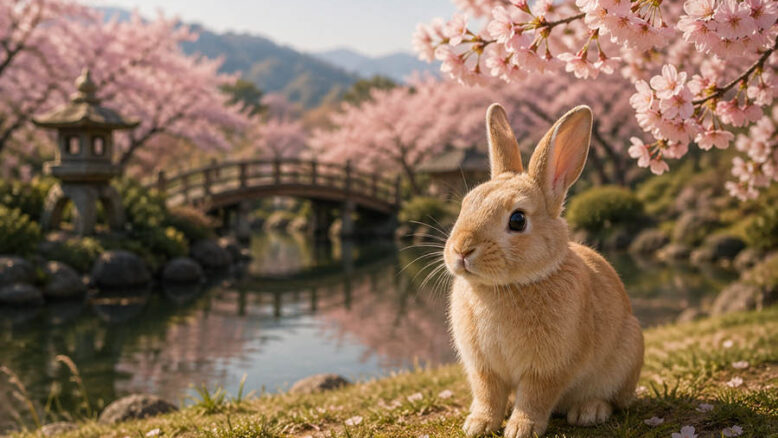
Look at the full moon in Japan and you will see a rabbit. Not a face, not a crater pattern, but a rabbit — pounding mochi with a mortar and pestle, working through the night. That image is so deeply embedded in Japanese culture that most people encounter it in childhood and never stop seeing it. The rabbit in Japan is lunar by nature, lucky by tradition, and warmly familiar in a way that gives this search genuine depth.
The Rabbit in Japanese Culture
The moon rabbit pounding mochi is one of the oldest and most universally recognised images in Japanese folklore — a figure so familiar that tsuki ni usagi (rabbit on the moon) needs no explanation to any Japanese person. It belongs to a broader East Asian tradition of seeing a rabbit in the moon’s surface patterns, one that was part of Japanese culture from its earliest recorded period.
The White Rabbit of Inaba is a different and older story, recorded in the Kojiki — Japan’s oldest written record, completed in 712 CE. A white rabbit tricked sea creatures to cross the water, was caught and stripped of its fur as punishment, then healed by the compassionate god Ōkuninushi. The story carries themes of honesty, suffering, and recovery that give the white rabbit a moral depth beyond its colour.
The zodiac rabbit — 卯 (u) — is the fourth sign, associated with gentleness, artistic sensitivity, and careful perception. People born in Rabbit years are traditionally considered graceful and perceptive rather than bold. The 卯 kanji appears in real given names in a way that the standard 兎 (usagi, rabbit) does not — 兎 rarely appears in officially registered personal names in Japan, making the zodiac character the more practical entry point for direct rabbit naming.
Japanese Names That Directly Mean Rabbit
Direct rabbit names are primarily for pets, fictional characters, and creative naming.
Usagi (兎)
The standard Japanese word for rabbit, used as a name. Clean, direct, and immediately understood — in Japan the word carries the moon rabbit’s warmth alongside its literal meaning. Rarely used as an officially registered personal name but entirely natural as a pet name or a character name. For a female fictional character who is gentle, quick, and connected to lunar imagery, the name works without any additional framing. The most famous modern bearer is Usagi Tsukino, the protagonist of Sailor Moon, whose name combines rabbit and moon with complete intentionality.
Usako (兎子)
Combines 兎 (rabbit) and 子 — the common feminine name suffix. The rabbit child: a name that places the rabbit kanji into a conventional personal name structure with a warmth the standalone 兎 doesn’t quite have. The 子 suffix makes it feel like a personal name rather than a label. Still creative rather than conventional for official naming, but it reads as a genuine name rather than a word.
U (卯)
The zodiac rabbit character used as a name element. On its own, 卯 is clean and spare — a single kanji carrying the full weight of the Rabbit sign without requiring a compound. It appears most naturally as part of a larger name rather than standing alone, but as an element it is the most culturally grounded direct rabbit character available for official Japanese naming.
Shirousagi (白兎)
Means white rabbit — 白 (white) and 兎 (rabbit). Not a conventional personal name, but carrying specific mythological weight through the White Rabbit of Inaba story: the creature that was hurt, healed, and transformed by honesty and compassion. For a fictional character whose rabbit nature is specifically white and whose story involves recovery or being helped back to wholeness, the name carries that narrative directly.
Names From the Moon Rabbit Tradition
The moon rabbit connects rabbit naming to the full lunar vocabulary — one of the deepest and most beautiful naming wells in Japanese. These names reach the rabbit through the moon it inhabits, giving them an indirectness that is more poetic than a direct animal name and often more usable as a real given name.
Tsuki (月)
Means moon. The rabbit’s home, its defining association, and the image every Japanese person brings to the word usagi. As a given name 月 is spare and luminous — a name that carries the full weight of the moon rabbit tradition through the single character that matters most. Used as a real Japanese girl’s name with a gentle, silvery quality that suits the rabbit’s lunar dimension precisely.
Mitsuki (満月 / 光月)
Written as 満月 (full moon) or 光月 (moonlight) depending on the kanji. The full moon is the night the rabbit is most visible — the pounding of mochi at its most vivid, the figure in the silver disk at its clearest. A real and widely used Japanese given name for both boys and girls, with a warm luminosity that carries the moon rabbit’s most iconic moment.
Saku (朔)
Means new moon — the dark phase, when the lunar surface goes black and the rabbit disappears from view. 朔 is the classical term for the first day of the lunar month, the moon’s reset point. For a name that carries the rabbit-moon connection through the moon’s hidden face rather than its full brightness, Saku finds a quieter, more introspective angle on the same tradition.
Tsukiusagi (月兎)
Means moon rabbit directly — 月 (moon) and 兎 (rabbit). The compound names the tradition itself rather than either element separately. Not a conventional personal name and rarely used as one, but as a fictional name or a pet name it states the moon rabbit connection without any room for ambiguity. For a character whose entire identity is rooted in that tradition, the name makes the meaning explicit.
Tsukiko (月子)
Combines 月 (moon) and 子 — the common feminine name suffix. Moon child: a real and well-used Japanese girl’s name that places the moon kanji into a conventional personal name structure. The 子 suffix gives it the warmth and personal quality of an actual name while the 月 keeps the moon rabbit tradition present. Traditional in feel and genuinely usable for a real person.
Names From the Zodiac Rabbit
The zodiac rabbit — 卯 (u) — generates a real naming tradition in Japan, with children born in Rabbit years sometimes given names incorporating the character. The Rabbit year’s traditional associations — gentleness, careful perception, artistic sensitivity — give these names a particular quality that is cultural and purposeful rather than simply symbolic.
U (卯)
The zodiac character for rabbit used as a name element. In this zodiac context the single character carries the Rabbit year’s full set of associations: grace, perceptiveness, and a quiet kind of luck. It appears most naturally as a prefix in compound names, and the entries below show how it functions in traditional constructions.
Uichi (卯一)
Combines 卯 (zodiac rabbit) and 一 (one, first). Traditionally given to firstborn sons born in a Rabbit year — the zodiac sign and birth order combined into a single name. A name with clear cultural purpose behind its construction, belonging to a tradition of Japanese naming that takes the year of birth as a meaningful part of identity.
Unosuke (卯之助)
Built from 卯 (zodiac rabbit), の (possessive particle), and 助 — a classical male name suffix appearing widely in historical Japanese naming. The formal construction places the zodiac rabbit in a register belonging to an older Japan: samurai literature, period settings, a character whose name should feel both specific and classical. Not a name for everyday modern use but immediately legible in period fiction.
Utarō (卯太郎)
Combines 卯 (zodiac rabbit), 太 (big, robust), and 郎 (son — the classical male name suffix). A traditional male name construction that places the rabbit zodiac sign into one of the most established patterns in historical Japanese male naming — zodiac character, then 太, then 郎. Grounded and sturdy in feel, with the rabbit year’s gentleness carried inside a name that reads as warm and substantial.
Names That Capture Rabbit Softness and White
The rabbit’s physical presence — soft white fur, round and quiet, warm to hold — connects it to a set of names drawn from whiteness, silk, snow, and gentle texture. These names reach the rabbit through what it feels like rather than what it does.
Shiro (白)
Means white. The rabbit’s most essential visual quality and the colour of both the moon rabbit and the mythological White Rabbit of Inaba. As a given name, Shiro is spare and direct — the thing itself without elaboration. The white rabbit tradition is one of Japan’s oldest, and Shiro carries the full depth of that association in a single kanji.
Kinu (絹)
Means silk — the textile that comes closest to describing the texture of a rabbit’s coat. Smooth, soft, and with a particular warmth that cotton and wool don’t quite match. Used as a given name in Japan, though it is relatively uncommon. For a name that reaches the rabbit’s softness through material quality rather than colour, Kinu is precise and genuine.
Shirayuki (白雪)
Means white snow — 白 (white) and 雪 (snow). In Japanese tradition, yukiusagi (雪兎) — snow rabbits — are small decorations made from balls of snow shaped into rabbits, with red berries for eyes, traditionally made in winter and associated with the new year. The name carries that specific image: winter white, round and still, a rabbit made of snow. A real Japanese given name with a clean, cool beauty.
Yū (柔)
Means soft, gentle, or yielding — 柔 is the kanji in jūdō (柔道, the gentle way). As a standalone given name it is uncommon and suits creative or fiction-leaning use rather than conventional naming. For a name that describes the rabbit’s essential quality — the softness that is also a kind of strength, the gentleness that endures — the kanji says it directly.
Fuwari (ふわり)
Means softly, fluffily, or the quality of something light and yielding — written in hiragana rather than kanji, which gives it a deliberately soft, informal feeling. Occasionally used as a given name in Japan, more common as a pet name. The word names the specific quality of rabbit fur: not silk’s smoothness, not wool’s weight, but that particular cottony lightness that belongs to the animal itself.
Names That Capture Rabbit Speed and Lightness
The rabbit’s speed is a specific kind — not sustained power but sudden, zigzagging, and immediate. It changes direction mid-stride, reaches full pace in an instant, and is gone before the eye has finished tracking where it was. These names draw on that quality of movement.
Kakeru (翔)
Means to soar, dart, or move swiftly through open space. The kanji 翔 captures movement that is fast and open — not confined, not laboured, but released. A rabbit bounding across open ground moves with exactly this quality: committed and quick, the body fully extended. A real and widely used Japanese name for both boys and girls, with a clean, free energy.
Shun (瞬)
Means an instant or a flash — the duration of a single blink. The rabbit’s movement happens in this interval: one moment present, the next gone, the eye unable to track the transition. Shun is a real Japanese given name that captures that quality of speed so absolute it doesn’t feel like movement but like disappearance.
Tobi (飛)
Means to fly or to leap — 飛 is the kanji of things that leave the ground. The rabbit’s bounding leap at full speed lifts it briefly clear of the earth, the body fully stretched. As a given name Tobi is relatively uncommon and suits creative use over conventional naming, but the leaping quality is direct and the kanji is immediately understood.
Hayase (早瀬)
Combines 早 (swift, early) and 瀬 (shoals, rapids — the place where water moves fastest). A real Japanese name that captures the quality of something fast and fluid: not a burst of speed but a sustained quick movement, the way water finds the fastest path through whatever is in front of it. The rabbit’s zigzag through obstacles has exactly that adaptive swiftness.
Hane (羽)
Means feather or wing — the quality of something so light that speed costs it almost nothing. The rabbit at full pace has a similar quality: the body barely seems to touch the ground, the effort invisible, the movement effortless. A real Japanese name with a spare, light quality that suits the rabbit’s movement through its lightness rather than its power.
Rabbit Names for Boys
For a male character or boy with rabbit energy, these names draw on the moon tradition, the zodiac sign’s associations, and the rabbit’s qualities of swift perception and lunar connection.
Tsukito (月斗 / 月人)
Combines 月 (moon) and 斗 (the Big Dipper — a common name element suggesting scale and navigation) or 人 (person). The moon person: a male lunar name that carries the rabbit’s celestial home in a grounded, masculine construction. A real Japanese given name with a calm, open quality — the moon as a place of navigation rather than simply an object of beauty.
Uichi (卯一)
Combines 卯 (zodiac rabbit) and 一 (first). The firstborn of the Rabbit year — a name that carries cultural purpose and a specific kind of luck. Quiet and traditional in register, it suits a male character whose gentleness is a form of strength rather than an absence of it.
Gin (銀)
Means silver. The moon is silver, the rabbit’s pale coat catches the same cool light, and the snow rabbit is made of the same winter white that silver describes at night. As a given name Gin is spare and striking — a single kanji that names the colour of the moon rabbit’s world. Used as a real Japanese name with a cool, precise quality.
Haku (白)
The on’yomi reading of the white kanji, carrying a slightly more formal, crystalline quality than the kun’yomi Shiro — white as something rare and deliberate rather than simply descriptive. A real Japanese name used for both the colour and the quality of something genuinely pure. For a male rabbit character whose whiteness is a defining feature, the on’yomi reading carries that intentional dimension.
Shun (瞬)
The flash and the instant — the rabbit’s speed at its most concentrated. As a male name Shun carries the rabbit’s quickness alongside a quality of perception: the instant in which something is registered before anyone else has noticed it. A real Japanese male name with a sharp, clear energy that suits the zodiac rabbit’s traditional associations of perceptiveness as much as its physical speed.
Rabbit Names for Girls
For a female character or girl with rabbit energy, these names draw on the moon, the rabbit’s gentle presence, and the soft winter imagery that connects the rabbit to the most beautiful season for moon-watching.
Usagi (兎 / うさぎ)
The rabbit itself — used as a girl’s name with the warmth and directness that the word carries in Japanese. In Japanese pop culture, Usagi is an overwhelmingly feminine name, carrying the moon rabbit tradition, the White Rabbit of Inaba’s recovery story, and the general warmth of the animal. For a female character defined by gentleness, speed, and a connection to the moon, the name states it all without needing support.
Tsukimi (月見)
Means moon viewing — 月 (moon) and 見 (to see, to look). The autumn tradition of sitting outside to watch the full moon, with offerings of mochi and autumn grasses — and beside those mochi, the rabbit who made them. Tsukimi is a real Japanese given name that carries the moon rabbit’s presence through the practice of watching for it. A name for a girl whose relationship to beauty is patient and attentive.
Koyuki (小雪)
Means small snow — 小 (small) and 雪 (snow). The snow rabbit (yukiusagi) made in winter is always small: a handful of snow shaped carefully into something soft and round. Koyuki carries that same quality — small, white, gently present, made of something that will eventually melt but is beautiful while it lasts. A real Japanese girl’s name with a tender, wintry quality.
Tsukiyo (月夜)
Means moonlit night — 月 (moon) and 夜 (night). The rabbit’s domain: the hours between sunset and dawn when the moon is highest and the rabbit most fully itself. As a name Tsukiyo carries that specific quality of night that is not dark but lit from above — the silver world the moon rabbit inhabits. A real Japanese given name with a cool, luminous quality that suits a girl character defined by her relationship to the night.
Fuku (福)
Means fortune, blessing, or happiness. The rabbit is one of Japan’s luckiest zodiac signs — associated with good outcomes, careful navigation of difficulty, and the quiet accumulation of good fortune over time. Fuku captures that dimension directly: warm, steady luck that comes from something gentle and perceptive moving carefully through the world. A real and widely used Japanese name.
Final Thoughts
The rabbit in Japan sits at an unusual intersection: genuinely ancient — the moon rabbit tradition was present from Japan’s earliest recorded culture — and immediately warm, the most approachable of any animal this naming territory covers. A rabbit name can carry the weight of the Kojiki, the depth of the lunar tradition, or simply the softness of something small and quick and white. That range from mythological depth to straightforward warmth is exactly what makes the rabbit worth naming. The right name depends on which rabbit you are actually reaching for.