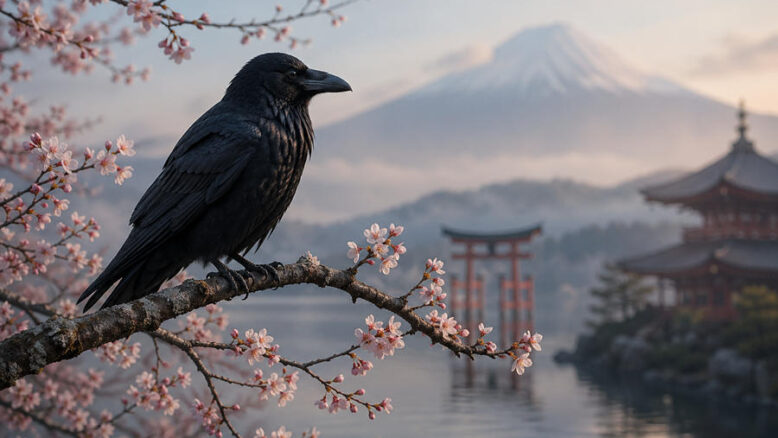
The crow in Japan is not simply a dark omen. It guides emperors, teaches sword techniques to legendary warriors, and serves as the direct messenger of the sun. At the same time, it circles battlefields, its call has been associated with death for centuries, and its black silhouette against grey sky is one of Japanese poetry’s most enduring images of solitude and passing time. That duality — sacred and ominous, brilliant and dark — is exactly what makes crow names so useful for fiction, and why they reward a closer look than the colour alone suggests.
The Crow in Japanese Culture — Sacred and Ominous
The most important crow in Japanese tradition is the Yatagarasu — the three-legged divine crow sent by the gods to guide Emperor Jimmu on his founding journey across Japan. Its three legs are often associated with the three phases of the solar day, though the specific significance varies across sources. The Yatagarasu is not a creature of darkness — it is a creature of solar divinity operating in the world’s shadow, which is precisely what gives it power.
The karasu tengu (烏天狗) — the crow-faced mountain spirit — occupies a different register. These are supernatural beings of great martial power and unpredictable temperament, associated with mountain wilderness and capable of both protecting and destroying. The tengu of Kurama mountain is said to have taught sword techniques to the young Minamoto no Yoshitsune, one of Japan’s most celebrated warrior heroes.
In classical poetry, the crow’s most famous appearance is in Matsuo Bashō’s autumn haiku — a crow settling on a bare branch as evening falls, an image of stillness and solitude that has defined the bird’s literary character for centuries.
The standard kanji for crow, 烏 (karasu), almost never appears in personal names. The associations are simply too heavy for most naming purposes. What it offers instead is a set of mythological, symbolic, and visual connections that fiction writers can draw on precisely and honestly.
Japanese Names That Directly Mean Crow or Raven
Direct crow kanji names are fiction and pet territory — no caveats needed beyond stating that clearly.
Karasu (烏)
The primary Japanese word for crow or raven, written with the kanji 烏. As a personal name it is essentially unused in everyday Japanese naming — the connotations are too singular and too dark for most families. For fiction, though, it states its meaning without ambiguity: a character named Karasu is a crow, and everything that carries with it in Japanese mythology. For a black cat, dog, or bird, it works with the same directness.
Karasu (鴉)
The literary and archaic alternative kanji for crow, 鴉, also read as karasu in Japanese. Where 烏 is the common word, 鴉 appears in classical poetry, older texts, and contexts where the crow’s literary darkness is being invoked deliberately. Using 鴉 rather than 烏 for a fictional character name signals something — that the naming is conscious, poetic, and reaching for an older register. The distinction is one of tone rather than meaning.
Karasuma (烏丸)
Combines 烏 (crow) and 丸 (circle, completeness — a traditional Japanese name element). Karasuma is a real place name in Kyoto — one of the city’s main north-south streets, running through the heart of the old capital. Used as a Japanese surname, it carries the crow kanji with the grounding of genuine geographic and historical depth. For a fictional character connected to Kyoto or old Japan, the name has texture that purely invented crow compounds lack.
Kurohane (黒羽)
Means black feather — 黒 (black) and 羽 (feather, wing). Not the crow kanji, but visually and immediately connected — the crow’s defining feature rendered as a name. Used as a creative given name in Japanese fiction and occasionally as a real name. The black feather carries the crow’s presence without requiring the 烏 kanji’s full weight, which gives it slightly more flexibility across naming contexts.
Names From the Yatagarasu Tradition
The Yatagarasu is one of Shinto’s most significant divine creatures — not a simple animal symbol but a specific sacred being with its own mythology, iconography, and ongoing cultural presence. Its image appears on the badge of the Japan Football Association and in countless works of art, manga, and fiction. Names in this section draw on its role as divine guide, solar messenger, and embodiment of sacred intelligence.
Yatagarasu (八咫烏)
The three-legged divine crow itself — 八咫 (great span, vast) and 烏 (crow). Not a personal name in any conventional sense, but for a fictional character who is ancient, divine, and guiding something larger than themselves toward its destination, nothing in Japanese mythology carries this exact combination of solar power and directional purpose. Fiction only, and the scale of the name makes that clear.
Michibiki (導き)
Means to guide or to lead. The Yatagarasu‘s defining role — it does not fight or destroy, it guides. The kanji 導 carries active direction: showing the way through difficult terrain, pointing toward something others cannot see. A real Japanese word used occasionally as a name, with a quiet authority that suits a character whose power lies in direction rather than force.
Sōen (蒼炎)
Combines 蒼 (deep blue, vast — the blue of a deep sky or the sea) and 炎 (flame). A creative compound rather than a conventional name, but one that captures the solar energy the Yatagarasu serves — the blue flame of a clear sky at the height of the sun’s power. For a character connected to the divine crow’s celestial dimension rather than its dark one, the name finds a different angle on the same mythology.
Kashiko (賢)
Drawn from 賢 (wise, discerning, clever) — the kanji that describes the particular quality of the Yatagarasu‘s perception: the crow that sees the right path when the emperor cannot. Used in Japanese given names — Kenshin, Kenji, and others carry this kanji — and as a standalone element it captures sacred discernment rather than ordinary intelligence. Worth distinguishing from the kashikoi adjective form, which reads as an everyday descriptor rather than a name.
Names From the Karasu Tengu Tradition
The karasu tengu — the crow-beaked mountain spirit — is a different figure from the long-nosed dai-tengu. Both are tengu, but the crow-faced variety is wilder, less predictable, and more directly associated with the mountain wilderness where they dwell. They are beings of enormous martial power who operate outside ordinary social structures, answering to their own codes. The techniques they passed on to legendary heroes like Yoshitsune became the stuff of some of Japan’s most enduring warrior stories.
Tengu (天狗)
The mountain spirit itself — 天 (heaven) and 狗 (dog, though the creature is bird-featured rather than canine). Rarely used as a personal name for obvious reasons — calling a character Tengu is a direct statement about their nature. For fiction where that directness is the point — an ancient, untamed being whose power precedes civilization — it works exactly as intended.
Kurama (鞍馬)
The mountain north of Kyoto where the tengu Sōjōbō is said to have trained the young Yoshitsune in the sword arts. Written with 鞍 (saddle) and 馬 (horse), the kanji describe the mountain’s physical character rather than its spiritual one — and that gap between the mundane characters and the extraordinary associations is part of what makes the name interesting. Used as a given name in Japanese fiction with consistent frequency. For a character shaped by wilderness, martial discipline, and a supernatural teacher, the name carries its full weight.
Hayate (疾風)
Means a violent, swift gust of wind — 疾 (swift, rushing) and 風 (wind). The tengu move through mountain air with the speed and force of a sudden gale — appearing and vanishing before anyone can track them. Hayate is a real and well-used Japanese name that captures that quality: fast, forceful, and carrying the weight of something natural and difficult to oppose.
Yaiba (刃)
Means blade or cutting edge. The martial tradition the karasu tengu represents — the sword as an extension of perception and will — is distilled into this single kanji. Rare as an everyday name but precise as a fictional choice: a character named Yaiba has something sharp at their centre, and the crow-tengu tradition gives that sharpness a specific mythological lineage.
Black and Shadow Names — The Crow’s Darkness
The crow’s colour is as much a part of its character as its mythology. Black in Japanese culture is the colour of formality, night, hidden things, and the edge between the visible and the invisible. These names reach the crow through darkness rather than through the 烏 kanji directly.
Kuro (黒)
Means black. The most direct colour name in Japanese — clean, spare, and carrying the full weight of its meaning without elaboration. Used as a given name and a common pet name throughout Japanese history. For a crow-named character or animal, Kuro states the essential quality without mythology or compound construction. The simplicity is its strength.
Kokuyō (黒曜)
Combines 黒 (black) and 曜 (radiance, the brilliance of celestial bodies). The full compound 黒曜石 (kokuyōseki) is the Japanese word for obsidian — black volcanic glass that catches the light with an iridescent shimmer — and 黒曜 draws on that visual quality: black with light moving through it, the same quality as a raven’s feathers shifting between pure black and blue-green depending on the angle. A creative compound rather than a conventional name, but precise in its imagery.
Kage (影)
Means shadow — the dark shape cast by something passing overhead, the presence that precedes the crow’s arrival. A real Japanese name used in both everyday and fictional contexts, with a stillness that suits a character who operates from the margins of things rather than their centre.
Tobari (帳)
Means curtain or veil — the threshold between what is visible and what is concealed. The crow inhabits that boundary in Japanese tradition: it arrives before dark events, circles at transitions, appears at the edges of things. Tobari names that liminal quality directly. A poetic rather than conventional name, suited to fiction where the character’s significance is atmospheric and difficult to pin down.
Mayonaka (真夜中)
Means midnight — 真 (true, pure), 夜 (night), 中 (middle). The pure middle of the night — the hour the crow owns, when the divine messenger has delivered its word and the ominous one is most itself. Rarely used as a personal name but immediately understood. For a fictional character whose defining quality is the absolute darkness between one day and the next, the compound is exact.
Crow Names for Boys
These names suit male characters and boys with crow energy — drawing on the bird’s intelligence, its connection to the tengu martial tradition, and the particular darkness it carries in Japanese mythology.
Kurou (九郎)
Traditionally means ninth son, written with 九 (nine) and 郎 (son, a classical male suffix). The crow connection is phonetic: the pronunciation kuro echoes 黒, meaning black, giving the name a shadow meaning that operates beneath the surface of its conventional characters. The gap between the written meaning and the heard one is exactly the kind of layered quality that suits a crow-named character. Worth being clear that the connection is sonic rather than kanji-based.
Kareki (枯木)
Means bare or withered branch — 枯 (withered, dried up) and 木 (tree). The crow on a bare branch in Bashō’s autumn haiku is one of the most iconic images in Japanese literature — the bird perched in stillness as the light fails. Kareki names that image rather than the crow itself, which gives it an oblique, literary quality. For a character whose crow nature is expressed through atmosphere rather than direct statement, the name works precisely because it asks the reader to make the connection.
Sōma (蒼馬)
Combines 蒼 (deep blue, vast — the blue-black of night sky or a raven’s wing in certain light) and 馬 (horse). A real Japanese given name whose visual quality — the deep blue-black of something moving fast through open space — maps naturally onto the crow’s iridescent darkness and swift movement. The horse imagery adds energy and wildness to the colour quality.
Renji (烈二)
Combines 烈 (fierce, intense, burning) and 二 (second, a common birth-order name element). Sharp energy and a clean sound — the crow’s ferocity without its stillness, the intelligence expressed as force. A usable creative name with a direct, unambiguous character.
Crow Names for Girls
The crow’s feminine associations in Japanese culture run toward the sharp-eyed and the undeceivable — a woman who sees through pretense, who carries herself with dark composure, who is more dangerous than she appears. These names suit female characters who occupy that space.
Tsukikage (月影)
Means moonlight shadow — 月 (moon) and 影 (shadow). The crow at night, its outline visible against a lit sky, its features lost in darkness — that specific image. A creative compound with a cool, atmospheric quality that suits a character defined by presence in darkness rather than absence of light. Used in Japanese fiction as a name with genuine resonance, though rare in everyday naming.
Kuraha (黒羽)
Means black feather — 黒 (black) and 羽 (feather, wing). As a girl’s name the single black feather carries elegance alongside its darkness — the crow’s presence distilled into one precise image rather than the whole bird. The sound is quiet and the meaning is exact.
Yoru (夜)
Means night. Spare and exact — not the colour of the crow but the time it owns. A creative given name used in modern Japanese fiction, rare in everyday naming but immediately understood. For a female character whose nature is nocturnal, hidden, and operating in the space between one day and the next, the single kanji is sufficient.
Kagero (陽炎)
Means heat haze — 陽 (sunlight, warmth) and 炎 (flame, shimmer). The shimmer of hot air rising from dark ground: a presence that is visible but not quite there, blurring what should be fixed and steady. The crow operates the same way — appearing suddenly, vanishing before the meaning of its appearance is clear. As a feminine name Kagero carries that elusive, atmospheric quality: dark without being simply dark, present without being pinned down.
Haguro (羽黒)
Means black feather — 羽 (feather, wing) and 黒 (black), the characters reversed from Kuraha but carrying the same visual core. Most significantly, Haguro is the name of Mt. Haguro in Yamagata Prefecture — one of the three sacred mountains of Dewa, a centre of shugendo mountain asceticism for over a thousand years. The mountain and its dark forest, its ancient cedar avenue, and its long association with yamabushi practitioners give the name the same quality as Karasuma and Kurama: crow imagery grounded in real geography and sacred history. For a female character connected to wilderness, spiritual power, and the shadow side of the sacred, it carries more depth than a purely invented compound.
Final Thoughts
The crow in Japan operates across registers that most symbols don’t reach — divine messenger and battlefield omen, martial teacher and poetic image of solitude, sacred servant of the sun and creature of absolute black. A crow name doesn’t settle into a single meaning. It carries the tension between those readings, and leaves the question open. That is what makes it useful for fiction: a character named with crow imagery in Japanese carries all of that weight without requiring explanation. The name does the work that backstory usually has to.