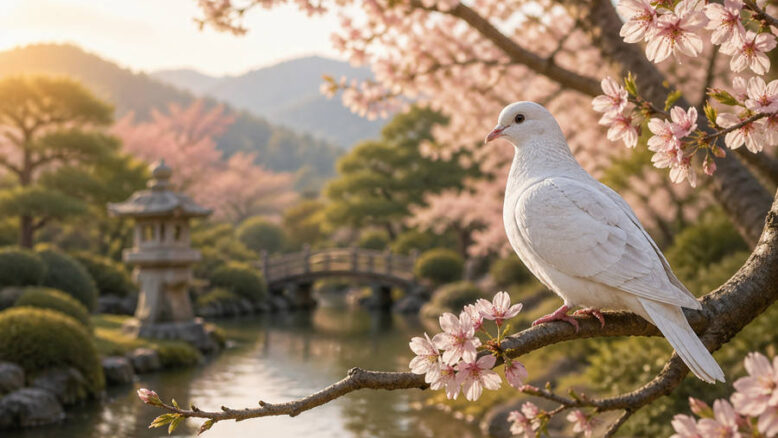
The dove in Japan is not just the peace symbol most people expect. It is also the sacred messenger of one of Japan’s most widely worshipped deities — the god of war. That contrast, between the gentle white bird and its role at the gates of warrior shrines, gives dove names in Japanese an unexpected depth. The word for dove and pigeon is the same, 鳩 (hato), and the specifically peaceful image is the white dove (shiro-hato) — a distinction worth understanding before choosing a name.
The Dove in Japanese Culture
鳩 (hato) covers both dove and pigeon in Japanese — the language makes no distinction between them. The white dove as a symbol of peace arrived in Japan primarily through post-WWII imagery and the influence of Pablo Picasso’s lithograph, which became an international symbol of the peace movement. In a country whose post-war constitution formally renounces war, that peace symbolism carries genuine national weight rather than being simply a borrowed image.
The indigenous tradition is richer and more surprising. The dove is the sacred messenger — o-tsukai — of Hachiman, the Shinto god of war, archery, and the protection of Japan. Doves flock at Hachiman shrines across the country, particularly at Tsurugaoka Hachimangu in Kamakura, where they are treated as divine. The god’s messenger is also the symbol of peace — the same bird, carrying both meanings at once.
The 鳩 kanji appears in Japanese surnames — most visibly in the family name of former Prime Minister Hatoyama Yukio (鳩山由紀夫) — and in place names, but it is uncommon in personal given names.
Japanese Names That Directly Mean Dove
Direct dove names are uncommon in everyday Japanese naming but coherent for fiction, character naming, and pet use.
Hato (鳩)
The dove kanji used as a standalone name. Clean and direct, though its use as a personal name is rare in Japan. For a pet dove or pigeon, it works without qualification. For a fictional character whose defining quality is peace, gentleness, or a connection to the Hachiman tradition, it carries the full weight of both the bird’s meanings without requiring any compound structure.
Hatoko (鳩子)
Combines 鳩 (dove) and 子 — the common feminine name suffix. A real Japanese naming pattern that places the dove kanji into a conventional personal name structure. The 子 suffix softens the directness of the dove kanji and gives the name a warmer, more personal quality than Hato alone. Traditional in feel and usable as a real name for an actual person.
Shirohato (白鳩)
Means white dove — 白 (white) and 鳩 (dove). The specifically peaceful image: the white bird released at ceremonies, carried in paintings, associated with international understanding. Rare as an everyday personal name but direct and unambiguous for fiction or creative naming. For a character whose peace symbolism should be explicit rather than associative, the compound states it without elaboration.
Hatonosuke (鳩之助)
Built from 鳩 (dove), の (possessive particle), and 助 — a classical male name suffix that appears widely in historical Japanese naming. The formal, traditional construction places the dove kanji in a register belonging to an older Japan — period fiction, historical settings, or a character whose name should feel both specific and classical. Not a name for everyday modern use.
Names From the Hachiman Dove Tradition
At Hachiman shrines across Japan, the dove is not decorative — it is sacred. The bird serves the god of war and protection, carrying messages between the divine and human worlds. Names in this section draw on that tradition: the dove not as a symbol of passivity but as a messenger of purpose, protection, and sincere action.
Yahata (八幡)
One of the readings of Hachiman’s name — 八 (eight) and 幡 (banner, streamer). Yahata is a real place name in Japan (Yawata City in Kyoto Prefecture traces its name to a Hachiman shrine) and appears occasionally as a given name in historical and regional contexts. For a character connected to the Hachiman tradition — the warrior god whose messenger is a dove — the name carries that lineage directly. Leans toward fiction and historical naming rather than everyday modern use.
Mamoru (守)
Means to protect or to guard. The Hachiman dove’s role is ultimately protective — it serves a deity whose purpose is the defence of Japan and its people. Mamoru captures that dimension of dove symbolism: the peace that comes from being guarded rather than simply from the absence of conflict. A real and widely used Japanese name with a warm, grounded quality.
Tsukasa (司)
Means to govern, to administer, or to be entrusted with authority. The divine messenger carries authority as much as information — it arrives with purpose and leaves something changed. Tsukasa is a real Japanese given name for both boys and girls, with a quiet, purposeful quality that suits the dove’s role as an agent of something larger than itself.
Makoto (誠)
Means sincerity, truth, or genuine intent. The messenger’s essential quality — what is carried must be carried faithfully, without distortion or agenda. Makoto is one of the most established traditional names in Japan, used for both boys and girls, with a moral directness that suits the dove’s role as a trustworthy carrier between worlds. A name that has meant sincerity in Japanese culture for centuries.
Names That Capture Dove Peace and Gentleness
Post-war Japan’s constitutional pacifism gave peace names genuine national resonance — the kanji for peace and harmony are not abstract virtues in Japan but carry the weight of a specific historical choice. The names here draw on that tradition: peace as an active value rather than simply the absence of conflict.
Yasushi (靖)
Means peaceful, tranquil, or to bring calm. The kanji 靖 carries a sense of peace that has been actively established — a calm that exists because something has been resolved rather than simply avoided. A real and traditional Japanese male name, with a composed, settled quality that suits the dove’s image of peace after the storm has passed.
Nagomi (和み)
Means harmony, ease, or a sense of things being gently settled. 和 is one of the most important kanji in Japanese culture — it appears in the country’s oldest name for itself, Yamato (大和) — and 和み captures its softer dimension: the warmth of things in agreement rather than in tension. A real Japanese given name with a gentle, unhurried quality that sits naturally alongside dove symbolism.
Mutsumi (睦)
Means harmony, affection, or the closeness of people who belong together. The kanji 睦 describes a relational peace — not the absence of conflict but the presence of genuine connection. For a name that carries the dove’s gentleness through the quality of its relationships rather than its solitude, Mutsumi is precise. A real Japanese name used for both boys and girls.
Nozomi (望)
Means hope, wish, or the desire for something better ahead. Peace is as much a hope as a condition — the dove released carries the wish for something that doesn’t yet exist. Nozomi is one of the most widely used Japanese names and carries that forward-looking quality: not peace as a settled fact but peace as what is being reached for. A name with warmth and genuine optimism built into its single kanji.
Heiwa (平和)
Means peace directly — 平 (flat, level, calm) and 和 (harmony). The standard Japanese word for peace, and rarely but genuinely used as a given name. Worth noting the rarity clearly: most Japanese families would find Heiwa as a personal name unusual, in the same way an English-speaking family naming a child Peace might. For a fictional character for whom peace is not just a quality but an identity, the name states it without metaphor.
Names Tied to White and Gentle Radiance
The white dove’s visual quality — pale, clean, luminous against any background — connects it to a set of names drawn from whiteness, purity, and the kind of clear, undimmed light that belongs to morning rather than midday. These names reach the dove through colour and clarity rather than through the 鳩 kanji directly.
Shiro (白)
Means white. The dove’s defining colour as a name — spare, clean, and immediately connected to the white dove tradition. Used as a given name in Japan throughout history, with a brightness and simplicity that needs nothing added. For a dove-named character or animal where the white symbolism should be present without elaboration, Shiro states it directly.
Kiyoshi (清)
Means pure, clear, or uncontaminated. The dove’s whiteness is a purity — something that has not been touched by what darkens other things. Kiyoshi is a real and well-established Japanese male name whose kanji captures that quality precisely: not the absence of colour but the presence of something genuinely clean. The 清 kanji also suggests clear water, which places it in the same register as the dove’s association with gentle natural imagery.
Hakuchō (白鳥)
Means white bird or swan — 白 (white) and 鳥 (bird). The swan and the dove share the same visual language in Japanese culture: pale, graceful, associated with purity and the stillness of clear water. As a name, Hakuchō captures the dove’s whiteness through the broader white-bird tradition without requiring the 鳩 kanji. Used as a given name in Japan, though it is relatively unusual — it carries an elegant, quietly elevated quality.
Shirabe (調)
Means melody, harmony, or the quality of things being in tune. The dove’s call — soft, repetitive, unhurried — is one of the most gently consistent sounds in nature. Shirabe captures the harmonic dimension of the dove’s presence: not just peace as silence but peace as something that has a sound, a rhythm, a feeling of things in their right relation. A real Japanese given name with a musical and composed quality.
Sae (冴)
Means clear, crisp, or brilliant — the quality of a cold, cloudless sky where everything is defined and undimmed. The white dove against clear sky: that specific visual. Sae is a real Japanese girl’s name with a cool, precise clarity that suits the dove’s visual purity without being simply another whiteness name. The 冴 kanji appears in the expression sae-wataru (冴え渡る) — to be brilliantly clear across the whole sky.
Dove Names for Boys
For a male character or boy with dove energy, these names draw on peace as a value, the Hachiman protection tradition, and the quality of steady, purposeful calm that distinguishes the dove from more dramatic birds.
Taira (平)
The kanji 平 means peace, level, or calm — a steadiness that is both physical and moral, the quality of ground that is even and of a situation that has settled. Taira is also the name of one of Japan’s great historical warrior clans — the Taira, whose rivalry with the Minamoto shaped the country’s medieval history. The name carries both the peace meaning and that historical weight. For a male character in whom the dove’s peace and the warrior tradition are held in the same person, the kanji makes that possible without forcing it.
Yasumichi (靖道)
Combines 靖 (peaceful, tranquil) and 道 (road, path, way). A peaceful path: not just the condition of peace but the direction of it, the way a person walks through their life with calm purpose. A creative compound that follows natural Japanese naming patterns. For a male character defined by quiet, deliberate movement toward something good, the name earns its dove connection through what it describes.
Taihei (太平)
Means great peace — 太 (great, vast) and 平 (peace, level, calm). 太平 appears in the name of the Pacific Ocean in Japanese (太平洋 — the Great Peaceful Ocean) and in era names throughout Japanese history. As a given name it carries a sense of peace at a larger scale than personal temperament — the peace of a whole world being in order. Used as a real Japanese male name with a traditional, considered register.
Noboru (昇)
Means to rise or to ascend. The dove taking flight — lifting upward from stillness into open air. Noboru is a real and widely used Japanese male name with an aspirational, clean quality: movement that is upward and forward without force. The dove’s flight is not aggressive or hunting but simply free, and Noboru captures that quality of effortless ascent.
Ren (蓮)
Means lotus — the flower that rises from mud to bloom cleanly above still water. The lotus is one of Buddhism’s most important symbols: purity emerging from difficult conditions, peace that comes not from the absence of difficulty but from rising above it. The connection to dove symbolism is through that shared quality of whiteness and emergence — something clean and open reaching upward. A real and widely used modern Japanese name for both boys and girls.
Dove Names for Girls
For a female character or girl with dove energy, these names draw on gentleness, purity, and the particular quality of a calm that runs deeper than surface stillness.
Hatoko (鳩子)
Combines 鳩 (dove) and 子 — the common feminine name suffix. Traditional in construction and warm in feeling, it carries the bird’s full symbolism in a naming structure that reads as a genuine personal name rather than a symbolic statement. For a girl’s name where the dove connection should be present and direct, Hatoko states it without needing the symbolism explained.
Shizuka (静)
Means quiet, still, or serene. The dove’s particular kind of quiet — not the silence of something waiting or hiding but the stillness of something at rest, at ease, without urgency. Shizuka is a real and well-used Japanese girl’s name with a composed, unhurried quality that suits the dove’s temperament exactly. A name that carries gentleness without fragility.
Nagi (凪)
Means the calm after wind — the moment the water goes completely still and the air settles. The dove’s peace is often this kind: not the absence of disturbance but the return of calm after something has passed. Nagi is a real Japanese girl’s name that captures that specific quality — the peace that exists on the other side of difficulty rather than the peace that has never known it.
Yuki (幸)
Written with the happiness kanji 幸 rather than the snow kanji 雪, this reading of Yuki means good fortune, happiness, or blessing. The dove at Hachiman shrines — flocking in large numbers, treated as divine, associated with the god’s favour — carries this auspicious dimension alongside its peace symbolism. Yuki written with 幸 connects to that lucky, warm quality: the bird as a sign that something good is present. A real and widely used Japanese girl’s name.
Kotori (小鳥)
Means small bird — 小 (small) and 鳥 (bird). Affectionate, gentle, and tender in its simplicity. The dove as a small bird: close to people, familiar, present without drama. Kotori is used as a Japanese given name with a natural, unaffected warmth — a name that describes the bird in the most honest way rather than reaching for symbolism or mythology. For a girl character or a real child, it carries that quality of something simply and genuinely itself.
Final Thoughts
The dove in Japan holds two traditions simultaneously — the post-war peace symbol absorbed from the wider world, and the ancient sacred messenger of a warrior god. Both are genuine, both remain present, and the right dove name draws on whichever of those dimensions fits best. A name like Makoto or Mamoru belongs to the Hachiman tradition: purposeful, protective, grounded in service. A name like Nagomi or Nagi belongs to the peace tradition: still, warm, and describing a world where things have settled into their right relationship. The dove earns names at both ends of that range.