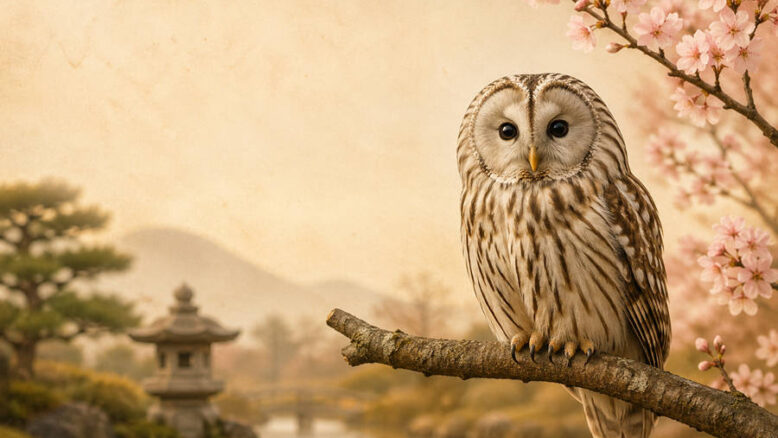
The owl holds an unusual position in Japanese culture — it is both an ancient omen of night and one of the most popular lucky charms in the country. That shift happened because of the Japanese language itself: the word for owl, fukurō, sounds identical to phrases meaning fortune arrives and without hardship. The wordplay transformed the bird’s image, and the result is an animal that carries both registers at once — the silent hunter and the gift shop charm. That duality makes owl names worth knowing.
The Owl in Japanese Culture — From Omen to Lucky Charm
The standard word for owl in Japanese is fukurō (梟 or フクロウ). In older regional folklore, the owl’s nighttime call was associated with death and misfortune — an omen heard before something went wrong. The on’yomi reading of the 梟 kanji also produces kyōyū (梟雄), a compound meaning a ruthless, dominating warlord — a word that captures the owl’s fiercer, more predatory dimension.
The transformation came through homophone wordplay. Fukurō sounds identical to 福来郎 (fuku-rō — fortune comes) and 不苦労 (fu-kurō — without hardship or suffering). Those auspicious readings turned the owl into one of Japan’s most popular lucky symbols — sold as charms, figurines, and omiyage gifts across the country. Owl cafés, where visitors can handle live owls, became a fixture of Tokyo and other major cities from the 2010s onward.
The 梟 kanji itself is not on the approved list of characters for use in Japanese given names (jinmeiyō kanji), so it cannot appear in an officially registered personal name in Japan. The owl’s presence in naming comes almost entirely through its wordplay, its symbolism, and the associative qualities the bird carries.
Japanese Names That Directly Reference the Owl
Three different written forms, one spoken sound — and each written form carries a different meaning. The homophone is both the owl’s name and its gift.
Fukurō (梟)
The owl kanji used directly — the standard written form of the bird’s name. Since 梟 is not approved for use in official Japanese given names, this belongs firmly in the realm of fiction and pet naming. For a fictional character who is nocturnal, precise, and operating at the intersection of the ominous and the wise, the kanji states the meaning without compromise. For a pet owl, it needs nothing added.
Fukurō (福来郎)
The auspicious reading — 福 (fortune, blessing), 来 (to come, to arrive), and 郎 (son, a classical male name suffix). Written this way, the name carries fortune arriving in the form of a person. The sound is the same as the owl’s name but the characters remove any shadow and replace it with welcome and abundance. A rare but coherent name choice for a boy, with the owl connection present in the sound and the luck present in the writing.
Fukurō (不苦労)
The second auspicious reading — 不 (not, without), 苦 (hardship, suffering), and 労 (labour, toil). Without hardship or suffering: a wish for a life free from struggle, expressed in the same syllables as the owl’s name. Less commonly used as an actual name than 福来郎, and the negative-particle construction is unusual in naming, but as a wordplay gift name — a charm rather than a conventional name — it carries the full weight of what the fuku-rō tradition means in Japanese culture.
Names From the Lucky Owl Tradition
The fuku-rō wordplay connects the owl to a whole tradition of Japanese auspicious naming built around fortune, the absence of suffering, and the hope for a good life. These names draw on that tradition through the 福 kanji and its family of related characters.
Fuku (福)
Means fortune, blessing, or happiness — the first element of fukurō and one of the most auspicious kanji in the Japanese language. Used as a real given name throughout Japanese history, particularly for girls, with a warmth and directness that suits both traditional and modern naming. The owl connection is phonetic and cultural rather than visual, but for a character or child whose name should carry the owl’s lucky dimension, Fuku states it in the most fundamental way.
Saiwai (幸い)
Means happiness, good fortune, or blessing — 幸 is one of the core kanji for well-being in Japanese. Used as a given name, Saiwai carries a gentle, quietly hopeful quality: not the dramatic arrival of fortune but its steady presence. The owl’s lucky tradition is about protection from hardship as much as the arrival of wealth, and Saiwai captures that quieter dimension of the wish.
Kotobuki (寿)
Means longevity, celebration, or congratulations — 寿 is used at weddings, new years, and auspicious occasions throughout Japanese culture. As a given name it carries the owl’s fuku connection through the broader auspicious tradition rather than the direct wordplay. A name that suits a character associated with good outcomes and long life, with a formality that distinguishes it from the warmer 福-based names.
Fukuko (福子)
Combines 福 (fortune) and 子 (the common feminine name suffix). A real and historically used Japanese girl’s name that places the owl’s lucky kanji directly into a conventional naming structure. The 福 reading carries the fuku-rō connection and the 子 suffix grounds it as a genuine personal name rather than a wordplay construction. Warm, traditional, and usable.
Yukichi (幸吉)
Combines 幸 (happiness, good fortune) and 吉 (luck, good omen). A real traditional Japanese male name that doubles the auspicious content — both kanji independently mean something fortunate, and together they carry a straightforward, unambiguous wish. Not an owl kanji name, but connected to the owl tradition through the fortune-and-luck register the fuku-rō wordplay inhabits.
Names That Capture Owl Wisdom and Perception
The owl’s association with wisdom is largely Western in origin — Athena’s owl, the wise old bird of European fairy tales — but it has been absorbed thoroughly into modern Japanese popular culture and shapes how many people approach owl names today. The names here draw on wisdom, clarity, and the particular kind of perception the owl represents: patient, still, and seeing what others miss.
Satoru (悟)
Means enlightenment, understanding, or awakening — the kanji 悟 carries Buddhist resonance, the wisdom that arrives through sustained attention rather than study alone. The owl’s stillness before it acts — hours of watching before the single precise movement — is the same quality the 悟 kanji describes. A real and established Japanese male name.
Tomo (智)
Means wisdom or knowledge — 智 is the kanji for active, applied intelligence, the kind brought to bear on the world rather than arrived at through inner reflection. A real Japanese given name for both boys and girls, with a clarity and precision that suits the owl’s perceptive, observational nature.
Ken (賢)
Means wise, discerning, or clever. The 賢 kanji appears throughout Japanese naming — in Kenshin, Kenji, and others — and as a standalone name it carries that tradition of careful, considered intelligence. For an owl-inspired name that centres the wisdom dimension without mythological or symbolic elaboration, Ken states it plainly.
Akira (明)
Means bright, clear, or luminous. The owl’s eyes in the dark — catching available light with precision far beyond what human eyes can manage — are its most visually distinctive feature. Akira captures that quality of seeing clearly when others cannot, a brightness that belongs to the night rather than to full sun. A real and widely used Japanese name for both boys and girls.
Minoru (実)
Means truth, substance, or to bear fruit — 実 is the kanji of things that are genuinely what they appear to be, with depth and content rather than surface only. The owl’s wisdom is of exactly this kind: not decorative or performed, but grounded in what it has actually observed. A real traditional Japanese male name.
Names Tied to the Owl’s Night and Silent Flight
The barn owl is one of the quietest fliers in nature — feather structure evolved specifically to eliminate noise. The owl hunts in genuine silence, seeing everything, heard by nothing. These names draw on that quality: stillness, the night, elusive movement, and perfect presence without announcement.
Shizuha (静羽)
Combines 静 (quiet, still) and 羽 (feather, wing). The silent wing — the physical quality of the owl’s flight made into a name. A creative compound rather than a conventional everyday name, but precise and visually direct. For a fictional character defined by quiet competence and the ability to move through situations without disturbing them, the compound captures the owl’s most distinctive physical quality.
Shinobu (忍)
Means to endure, to conceal, or to move with stealth. The 忍 kanji carries the quality of patient, sustained presence — waiting without announcing itself, moving without being tracked. The owl’s hunt is exactly this: extended stillness followed by precise, undetected movement. A real Japanese name with a long history in Japanese naming and literature.
Kasumi (霞)
Means mist or haze — present but not quite graspable, there in the peripheral vision and gone when looked at directly. The owl in the dark operates the same way: its outline visible against the sky, its details lost in the night. A real Japanese name used for girls, with a soft, atmospheric quality that suits the owl’s elusive, silent dimension.
Kanata (彼方)
Means the far distance, beyond, or over there — 彼 (that, over there) and 方 (direction, place). The owl’s gaze is directed into the dark at distances humans cannot resolve — it sees what is too far, too dim, too still for anything else to notice. Kanata is a real Japanese given name that carries that quality of perception aimed at what is distant and barely visible. A name that suits a character whose understanding extends further than those around them.
Yoru (夜)
Means night. The owl’s domain — not the edge of the night but its full depth, the hours when the bird is most itself. A creative given name used in modern Japanese fiction, spare and direct. For a character whose nature belongs to the dark hours, Yoru names the territory without metaphor.
Owl Names for Boys
For a male character or boy with owl energy, these names draw on the fortune tradition, the owl’s perceptive qualities, and the bird’s role as a silent, precise presence in the night.
Fukutarō (福太郎)
Combines 福 (fortune, blessing), 太 (big, robust), and 郎 (son — the classical male name suffix). A traditional Japanese male name that places the owl’s lucky 福 kanji into a conventional classical structure. The construction follows the same pattern as many historical Japanese male names and reads as grounded and traditional rather than creative. A name with genuine cultural roots in the auspicious naming tradition the fuku-rō wordplay belongs to.
Tōru (透)
Means to see through, to penetrate, or to be transparent. The kanji 透 carries the quality of light or perception passing through something that seems opaque — exactly the owl’s relationship to darkness. A real and established Japanese male name with a clarity and precision that suits a character defined by seeing what others cannot. The owl connection is visual and direct without requiring the bird kanji.
Kyō (梟)
The on’yomi reading of the owl kanji — the same character as fukurō read with its Chinese-derived pronunciation. Worth being direct: since 梟 is not approved for use in official Japanese given names, Kyō written with this kanji cannot appear on a Japanese family register. For fiction, however, the reading carries the owl’s fiercer dimension — the same kanji that forms 梟雄 (kyōyū, the ruthless warlord) — and suits a male character whose owl nature is shadowed rather than auspicious.
Hayami (速水)
Combines 速 (swift) and 水 (water). A real Japanese surname used as a given name, with the quality of something fast and fluid — the owl’s hunting dive, which drops with a precision that speed alone doesn’t capture. The water imagery adds smoothness to the speed: not a crash but a current, directed and inevitable.
Michishirube (道標)
Means guidepost or pathfinder — 道 (road, path) and 標 (marker, sign). The owl as a guide through darkness: not divine direction but the quieter guidance of something that simply knows where it is going when nothing else can see. More of a poetic word than a conventional personal name, but for a fictional character whose defining role is showing others the way through difficult terrain, the compound does exactly that.
Owl Names for Girls
For a female character or girl with owl energy, these names draw on the owl’s fortune dimension, its luminous perception, and the particular quality of its nighttime presence — still, watching, and precisely aware.
Fukuha (福羽)
Combines 福 (fortune, blessing) and 羽 (feather, wing). The fortune feather — the owl’s lucky dimension and its defining physical feature brought together in a single compound. A creative name rather than a conventional one, but the construction is coherent and the meaning earns its place in the fuku-rō tradition. For a female character whose owl nature is auspicious rather than ominous, the name says it directly.
Tsukimi (月見)
Means moon viewing — 月 (moon) and 見 (to see, to look). The owl’s nighttime vigil framed as one of Japan’s most beloved autumn traditions. Tsukimi is used as a real Japanese given name, carrying the owl’s patient watchfulness alongside the warmth and beauty of the moon-viewing festival. A name that finds a gentler angle on the owl’s night dimension without losing the precision of its gaze.
Hikaru (光)
Means radiance or light. The owl’s eyes are extraordinarily large relative to its skull — so large they are fixed in their sockets, requiring the owl to rotate its entire head to track movement. In the dark they appear fully open and luminous, gathering every available photon. Hikaru captures that quality: the light source in the darkness, fixed and aware. A real and widely used Japanese name for both boys and girls.
Shirone (白音)
Combines 白 (white) and 音 (sound, voice). The white sound — or rather the absence of it: the barn owl’s pale colouring and its near-silent flight brought together in a single compound. A creative name rather than a conventional one, reaching for the paradox of a bird defined by both its whiteness and its soundlessness.
Saiwai (幸い)
Means happiness, good fortune, or blessing. As a feminine name it carries the owl’s protective dimension — the wish for a life free from hardship — with a quiet, settled grace. A name that suits a female character who brings that quality to those around her without drama or announcement.
Final Thoughts
The owl is remarkable for having a Japanese name that is itself a wordplay on good fortune — and that accident of language shaped the bird’s entire cultural identity in modern Japan. The same sound that once signalled an omen at the edge of the forest now fills souvenir shops with ceramic figures and gift charms. Both readings are genuine, and both remain available. A name drawn from the owl in Japanese can carry the lucky dimension, the silent hunter dimension, or both at once — and the right choice depends on which side of the owl you are actually naming.