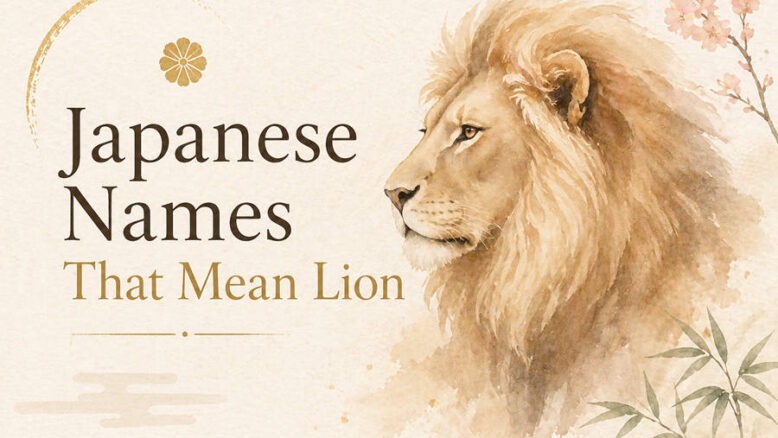
The lion stands for something different from the tiger or the wolf. Where the tiger is ferocity and the wolf is wildness, the lion is authority — majesty, leadership, and a presence that commands without effort. In Japanese culture, that image runs deep, even though lions have never lived in Japan. How that happened shapes every name in this article.
A Note on Lions in Japanese Culture
Lions are not native to Japan and have no place in its natural history. The cultural image of the lion arrived through Buddhism and Chinese artistic tradition — traveling the Silk Road before taking root in Japanese temples and shrines. The traditional Japanese word for lion is shishi (獅子), and the komainu (狛犬) — the stone guardian lion-dogs that flank the gates of shrines across Japan — are the most visible expression of that tradition today.
This matters for naming. Most Japanese names connected to lions draw on what lions represent in art, religion, and mythology rather than the animal itself. The 獅 kanji appears in some given names, but it is uncommon and skews toward fiction and creative naming.
Japanese Names That Directly Mean Lion
The kanji 獅 (shi) — the lion character — does appear in Japanese names, though not with the frequency of tiger. It works most naturally in compounds, and most of its direct uses lean toward fiction, martial arts culture, and creative modern naming rather than traditional everyday use.
Shishi (獅子)
The standard Japanese word for lion. In 獅子, the 子 functions as a noun-forming suffix rather than the name element it appears as in words like 太子 — it completes the compound rather than adding separate meaning. As a personal name Shishi is unusual — more a cultural reference than an everyday choice — but in fiction it carries immediate mythological weight. The shishi is a protector and a symbol of power in Japanese temple tradition, and the name brings all of that with it.
Shi (獅)
The lion kanji used alone. Rare as a standalone given name but clean and direct — a single character that states the meaning without elaboration. Best suited to fictional characters where brevity and impact matter more than conventional naming patterns.
Shion (獅音)
Combines 獅 (lion) and 音 (sound, voice). The lion’s voice — its roar — is inseparable from its image, and Shion captures that resonance directly. Works for both male and female characters. Note that Shion written with other kanji (such as 紫苑, aster flower) is a real and common Japanese name — this particular kanji combination is a creative choice rather than a standard one.
Shiro (獅朗)
Combines 獅 (lion) and 朗 (bright, clear, cheerful — a common element in male names). The 朗 suffix appears in many real Japanese names — 朗 reads as warm and human rather than fierce — which gives this compound a more natural naming feel than a bare 獅 construction. Still creative rather than conventional, but the 朗 component pulls it toward something usable.
Reona / Leona (レオナ)
The Western name Leona, now used in Japan as a modern given name. It’s borrowed from the Latin leo (lion) and carries that meaning intact. Used primarily for girls in Japan today, though the male form Reo (レオ) also appears in modern Japanese naming.
Names From the Guardian Lion Tradition
The komainu at Japan’s shrines and temples are not decorative. They are guardians — placed at gates to ward off evil, protect sacred space, and watch over those who pass through. One faces forward with an open mouth, one with a closed mouth, together forming the sounds a and un — the beginning and end of all things in Buddhist tradition. The names here draw on that protective role.
Mamoru (守)
Means to protect or to guard. Direct, warm, and in continuous real use in Japan — not a creative compound or a fiction-first choice, just a genuine name with guardian meaning built into it.
Shugo (守護)
Means guardian or protector — 守 (protect) and 護 (defend, safeguard). More formal than Mamoru and carries a weightier, institutional feel — the kind of protection that is structural rather than personal. Used in Japan historically as both a name and a title for provincial governors. For a character who embodies authority and defense in equal measure, Shugo earns its lion connection.
Jin (仁)
Means benevolence, humanity, or virtue. In Confucian and Buddhist thought — both deeply embedded in Japanese culture — the ideal protector is not merely strong but just. The guardian lions at temple gates embody that principle: their fierceness serves a purpose beyond themselves. Jin captures the moral dimension of the lion’s role rather than the physical one. A traditional name with genuine philosophical depth.
Gōki (剛毅)
Combines 剛 (tough, unyielding) and 毅 (resolute, determined). A name for the kind of strength that doesn’t waver — the lion that holds its ground at the gate regardless of what approaches. Uncommon in everyday naming, but specific and honest about what it means.
Names That Capture Lion Majesty and Leadership
The lion is a king. That symbolic role — authority, elevation, the leader of the pride — appears across Japanese culture in kanji tied to nobility, governance, and commanding presence.
Takashi (隆 / 崇)
Means noble, exalted, or prosperous — written with 隆 (prosperous, lofty) or 崇 (revere, exalt). One of the most established male names in Japan with this meaning, and a natural fit for lion-inspired naming that reads as regal without being theatrical.
Ōsamu (治)
Means to govern, to manage, or to bring order. The kanji 治 carries the sense of a leader who creates stability — not through force alone, but through wisdom and authority. A traditional name with weight that suits a lion-inspired character in a position of leadership.
Masaru (勝)
Means to excel, to win, or to prevail. Lions don’t compete — they simply prevail. Masaru captures that ease of dominance without the connotation of struggle. A traditional name still in use in Japan, with a clean, confident energy.
Kōki (皇輝)
Combines 皇 (emperor, imperial) and 輝 (radiance, brilliance) — a different kanji combination from Kōki (光輝) in the tiger article, same pronunciation with a distinctly more imperial meaning. Where that one meant luminous light, this one means imperial radiance. The register suits the lion’s role as a symbol of kingship, and both 皇 and 輝 are permitted for use in Japanese personal names.
Names Tied to the Mane, the Roar, and the Sun
The lion’s mane radiates outward like sunlight. Across cultures — and in Japanese art influenced by Chinese tradition — the lion and the sun share the same visual language: golden, blazing, and commanding in equal measure. These names draw on that imagery through kanji connected to the sun, radiance, sound, and resonance.
Taiyō (太陽)
Means the sun. Used as a given name in modern Japan and carries the full warmth and power of what it describes. The visual link between a lion’s mane and the sun’s rays is one of the oldest associations in lion iconography, and Taiyō brings that imagery into a real, usable name.
Hibiki (響)
Means resonance, echo, or reverberation. The kanji 響 captures not just sound but the way sound fills a space and lingers — exactly the quality of a lion’s roar. A real Japanese name used for both boys and girls, with a depth and richness that suits the lion’s voice without stating it literally.
Raiga (雷牙)
Combines 雷 (thunder) and 牙 (fang). The lion’s roar has always drawn the thunder comparison — both sudden, resonant, and filling the space around them completely. Raiga is a bold fictional name that captures that sonic force directly. Not a conventional everyday name, but vivid and immediate for character use.
Hiroshi (大 / 博)
Means expansive, generous, or broad — written with 大 (great, vast) or 博 (broad knowledge, wide). The lion’s presence is expansive in the same way: it fills whatever space it occupies. A well-established traditional Japanese name that carries that commanding scale naturally.
Akira (明 / 晶)
Means bright or clear — written with 明 (brightness, clarity) or 晶 (crystal, brilliance). Used for both boys and girls in Japan, Akira connects to lion imagery through the solar association: the lion as a creature of light, warmth, and visible power. A grounded and widely used name that works for both real naming and fiction.
Natsuki (夏輝 / 夏希)
Combines 夏 (summer) and 輝 (radiance) or 希 (hope). Summer is the season of full sun — bright, warm, and at full strength. For a lion-themed name that captures heat and radiance without using the lion kanji, Natsuki carries the association through season and light. Works for both boys and girls.
Lion Names for Boys
For a boy character or baby with lion energy, these names lean into strength, presence, and boldness — ranging from names that use the lion kanji directly to modern options with established real-world use.
Shōta (獅太)
Combines 獅 (lion) and 太 (big, robust). A construction that follows natural Japanese naming patterns — 太 appears in many real given names — and feels closer to an everyday name than most 獅 compounds. Bold without being unusual in register, and usable for both real naming and fiction where the lion connection should be present but not overbearing.
Reo (レオ)
The Japanese rendering of the Western name Leo, from Latin leo (lion). Used as a genuine given name in modern Japan with established real-world usage. Short, clear, and easy to carry — the lion meaning is direct and the name needs no explanation in either Japanese or Western contexts.
Taiga (大河 / 大牙)
Most commonly written 大河 — great river — a well-used real Japanese name with a powerful, expansive feeling. Written as 大牙 (great fang), it becomes a more overtly fierce choice suited to fiction. Both readings work for a lion-inspired male character, though 大河 is the more grounded and usable option for real naming. Worth being clear about which kanji you’re using.
Raion (ライオン)
The modern Japanese loanword for lion, written in katakana. Essentially never used as a personal name in conventional Japanese naming, but in fiction — anime, games, manga — a character named Raion would be immediately understood. It’s a direct statement rather than a subtle choice, which is exactly what some stories call for.
Shōma (獅磨)
Combines 獅 (lion) and 磨 (to polish, to refine). The 磨 kanji carries a sense of something honed to its best form — it appears in real Japanese names like Takuma (拓磨) and Kazuma (一磨), giving this compound a more natural base than most 獅 pairings. Still a creative choice rather than a conventional one, but coherent and considered in its construction.
Lion Names for Girls
Female lions are the hunters of the pride — precise, coordinated, and powerful in ways that don’t announce themselves. These names carry lion energy for girl characters or babies through grace, radiance, and quiet authority rather than roar and fang.
Shion (獅音)
The lion’s voice rendered as a name — resonant, strong, and with a sound soft enough for everyday use while the meaning holds real weight. Works particularly well for a female character who commands attention through presence rather than force.
Reona (レオナ)
Used primarily as a girl’s name in Japan — the female form where Reo is the male. The lion meaning is direct, the modern usage is genuine, and the sound is elegant without being elaborate. A name that works equally well for a contemporary character and for real naming.
Koharu (小春)
Means small spring or Indian summer — the brief warm spell in early winter when the sun returns unexpectedly. The lion’s mane has always carried solar imagery, and Koharu connects to that warmth through season rather than statement. A real and widely used Japanese girl’s name that carries sunlit, gentle strength without announcing it.
Kirara (煌 / きらら)
Means glittering or brilliantly shining, written with 煌 or in hiragana as きらら. It captures the visual impact of a lion in full sunlight — coat blazing, mane luminous. Used in modern Japan, more common in fiction but present in everyday naming. For a female character who is visually striking and commands attention the moment she enters a scene, Kirara fits.
Yuki (勇輝)
A different reading from the snow-Yuki (雪) in the cat article — here written with 勇 (brave) and 輝 (radiance). Brave radiance: the lion in full possession of its power. Works for both boys and girls in Japan, but as a girl’s name it carries a luminous, fearless quality that suits the female lion well.
Final Thoughts
The lion reached Japan not through the wild but through art, faith, and the long cultural exchange that shaped East Asian civilization. That indirect path is reflected in the names — they tend to reach for what the lion represents rather than the animal itself. Majesty, protection, solar radiance, the guardian at the gate. In some ways that makes lion names in Japanese richer than a direct translation search, because the tradition behind them carries meaning that goes well beyond a single kanji. The right lion name here isn’t just a label. It’s a statement about what kind of presence you’re trying to capture.