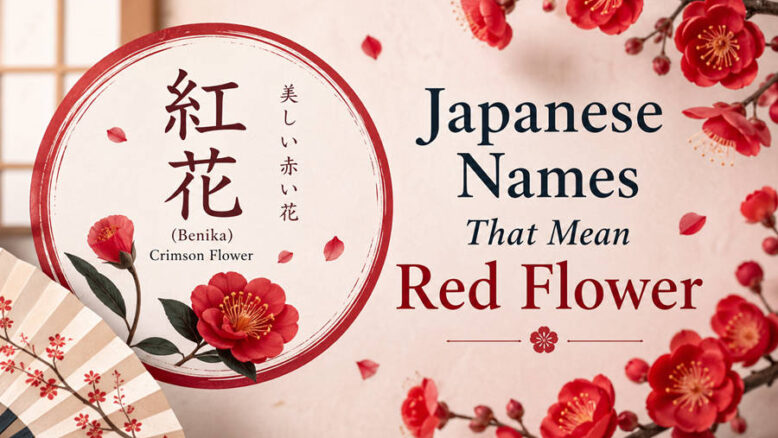
Japanese names that mean red flower can feel vivid, graceful, and full of natural beauty. Some names use kanji that directly combine red and flower, while others are poetic ideas inspired by crimson blossoms, scarlet petals, safflower, camellia, or red plum blossoms.
Because Japanese names depend heavily on kanji, the same sound can have different meanings depending on how it is written. In this guide, each name includes Japanese writing, hiragana, romaji, meaning, and a short note about whether it feels direct, poetic, rare, or better suited to character naming.
What “Red Flower” Can Mean in Japanese Names
A red flower name can be literal, but it can also carry a softer symbolic meaning. Red may suggest warmth, passion, courage, brightness, celebration, autumn color, or strong life energy. Flower imagery often suggests beauty, growth, freshness, gentleness, and natural charm.
Together, “red flower” creates the image of a blossom that stands out. It may feel romantic, bold, seasonal, elegant, or dramatic depending on the kanji. A name written with crimson or scarlet kanji usually feels more poetic than one using the plain kanji for red, while flower kanji gives the name a natural softness.
Red as a Name Symbol
The most direct kanji for red is 赤. It is clear and easy to understand, but it can feel very literal in a personal name. For a softer or more elegant impression, many red-themed name ideas use richer color kanji instead.
紅 suggests crimson or deep red. It often feels more graceful and poetic than 赤. 朱 means vermilion or cinnabar red, while 緋 means scarlet. These kanji can make a red-flower name feel brighter, more refined, or more dramatic.
Flower as a Name Symbol
The kanji 花 means flower or blossom. It can be read as hana or ka, and it appears in many Japanese names. In name meanings, flower imagery often suggests beauty, tenderness, hope, youth, and graceful growth.
When paired with red-color kanji, 花 can create meanings such as “red flower,” “crimson flower,” “vermilion flower,” or “scarlet blossom.” Still, a beautiful kanji meaning does not always make a common everyday name. Some combinations are natural name ideas, while others are better for stories, games, pen names, or symbolic use.
Direct Meaning vs. Poetic Meaning
It is helpful to separate direct meaning from poetic meaning. A direct red flower name uses kanji that literally combine red and flower, such as 赤花. A poetic red flower name may use kanji for crimson, scarlet, blossom, garden, fragrance, or beauty to create the feeling of a red flower without translating the phrase word for word.
This matters because Japanese names are not always built like English phrases. A kanji combination may look beautiful, but the reading may be rare or creative. For that reason, the names below are explained carefully instead of presented as equally common choices.
Useful Kanji for Names That Mean Red Flower
These are the main kanji used in red flower names and name ideas. Understanding them makes it easier to see which names are direct and which are more symbolic.
花 — Flower
Japanese writing: 花
Hiragana: はな / か
Romaji: hana / ka
Meaning: flower, blossom
花 is one of the most important kanji for floral names. As hana, it clearly means flower. As ka, it often appears at the end of names and gives a soft, graceful sound.
赤 — Red
Japanese writing: 赤
Hiragana: あか
Romaji: aka
Meaning: red
赤 is the most direct kanji for red. It is simple and clear, but it can feel plain or strongly literal in a personal name. A combination like 赤花 is easy to understand because it uses red plus flower.
紅 — Crimson or Deep Red
Japanese writing: 紅
Hiragana: べに / こう / くれない
Romaji: beni / kō / kurenai
Meaning: crimson, deep red, red coloring
紅 often feels more elegant than 赤. It appears in words connected with crimson color, safflower, cosmetics, and autumn leaves. For red flower names, it creates a rich and graceful impression.
朱 — Vermilion
Japanese writing: 朱
Hiragana: しゅ / あけ
Romaji: shu / ake
Meaning: vermilion, cinnabar red
朱 gives a vivid red-orange image. It can feel bright, traditional, and refined. When paired with 花, it creates the meaning “vermilion flower.”
緋 — Scarlet
Japanese writing: 緋
Hiragana: ひ
Romaji: hi
Meaning: scarlet
緋 has a strong and dramatic red meaning. It is less everyday than 赤, but it can be beautiful in creative names, especially for characters or poetic name choices.
Japanese Girl Names That Mean Red Flower
Red flower names often have a feminine feeling because 花 is common in girls’ names. The names below range from direct word-like compounds to softer creative name ideas.
Benika — 紅花
Japanese writing: 紅花
Hiragana: べにか
Romaji: Benika
Meaning: crimson flower, deep red blossom
Benika combines 紅, meaning crimson or deep red, with 花, meaning flower. It has a soft, elegant sound and gives a clear red-flower image.
This reading is best treated as a creative name reading. The same kanji, 紅花, are more commonly read as benibana, meaning safflower. For a personal name or character name, Benika feels more name-like, but the kanji should still be explained.
Kōka — 紅花
Japanese writing: 紅花
Hiragana: こうか
Romaji: Kōka
Meaning: crimson flower, red flower
Kōka is another reading of 紅花. It has a more formal and polished sound than Benika. The meaning can be understood as “crimson flower” or “red flower.”
This name works especially well for fiction, poetry, or symbolic naming. For everyday use, it may feel uncommon, so it is better presented as a rare or creative choice.
Akabana — 赤花
Japanese writing: 赤花
Hiragana: あかばな
Romaji: Akabana
Meaning: red flower
Akabana is the most literal red flower option. It uses 赤 for red and 花 for flower. The reading akabana follows a common sound change in Japanese where hana becomes bana in compound words.
As a word, akabana can also refer to a plant name or a traditional color term, so it should not be treated as a typical everyday given name. It is strongest as a direct nature name, character name, or symbolic choice.
Akahana — 赤花
Japanese writing: 赤花
Hiragana: あかはな
Romaji: Akahana
Meaning: red flower
Akahana uses the same kanji as Akabana: 赤 meaning red and 花 meaning flower. The difference is the reading. Akahana keeps the clearer hana sound, which may be easier for English-speaking readers to recognize as “flower.”
In Japanese, however, Akabana is the more natural compound reading. Akahana should be described as a creative reading rather than the standard form.
Shuka — 朱花
Japanese writing: 朱花
Hiragana: しゅか
Romaji: Shuka
Meaning: vermilion flower
Shuka combines 朱, meaning vermilion, with 花, meaning flower. The meaning can be understood as “vermilion flower.” It feels bright, graceful, and artistic.
The sound is short and smooth, which makes it easier to use than some longer red-flower combinations. It can work for a girl’s name idea, a gender-neutral character name, or a poetic pen name.
Hika — 緋花
Japanese writing: 緋花
Hiragana: ひか
Romaji: Hika
Meaning: scarlet flower
Hika uses 緋, meaning scarlet, and 花, meaning flower. The meaning is “scarlet flower.” This name has a vivid and dramatic feeling because 緋 is a strong color kanji.
Hika is simple in sound but bold in meaning. It may be especially suitable for a character with a fiery, elegant, mysterious, or artistic personality.
Benihana — 紅花
Japanese writing: 紅花
Hiragana: べにはな
Romaji: Benihana
Meaning: crimson flower
Benihana is a very direct reading idea from 紅, meaning crimson, and 花, meaning flower. It clearly gives the image of a crimson blossom.
This form is easier to understand than some creative readings, but 紅花 is still more commonly associated with benibana, the word for safflower. Because of that, Benihana works best as a poetic or character-style name rather than a standard everyday given name.
Japanese Boy Names Inspired by Red Flowers
Names that directly mean red flower are less common for boys because 花 often gives a softer or more feminine impression. Still, red-flower imagery can inspire strong boy names, especially when the name leans toward scarlet color, garden imagery, brightness, or seasonal symbolism.
Shuka — 朱花
Japanese writing: 朱花
Hiragana: しゅか
Romaji: Shuka
Meaning: vermilion flower
Shuka can also work as a red-flower-inspired boy name, especially for fiction. The kanji 朱花 means “vermilion flower,” but the sound is compact and not overly delicate.
For a real child, the flower kanji may still feel gentle or feminine to some people. For a character, however, Shuka can feel memorable, vivid, and balanced.
Hien — 緋苑
Japanese writing: 緋苑
Hiragana: ひえん
Romaji: Hien
Meaning: scarlet garden
Hien combines 緋, meaning scarlet, with 苑, meaning garden. It does not literally mean “red flower,” but it can suggest a garden filled with scarlet blossoms.
This name feels more dramatic than many direct flower names. It may suit a fantasy, historical, or anime-inspired character. Because the flower meaning is indirect, it should be described as red-flower inspired rather than a direct translation.
Shuen — 朱苑
Japanese writing: 朱苑
Hiragana: しゅえん
Romaji: Shuen
Meaning: vermilion garden
Shuen uses 朱, meaning vermilion, and 苑, meaning garden. Like Hien, it does not directly mean red flower, but it creates the image of a warm red garden or a place filled with bright blossoms.
This name is stronger as a character name than as a common baby name. It has a refined, slightly formal sound and works well for a red-flower theme without relying on 花.
Kōen — 紅苑
Japanese writing: 紅苑
Hiragana: こうえん
Romaji: Kōen
Meaning: crimson garden
Kōen combines 紅, meaning crimson, with 苑, meaning garden. The result is not “red flower” word for word, but it suggests a garden of crimson blossoms.
This is a poetic and uncommon option. It may be useful for a male character, surname-style name, place name, or symbolic name in a story.
Gender-Neutral Japanese Names With Red Flower Meanings
Some red flower names can feel gender-neutral, especially in fiction, games, pen names, or creative writing. In real-life use, gender impression depends on the sound, kanji, family preference, and cultural context.
- Benika — 紅花(べにか): A graceful crimson flower name. It leans feminine, but it can also work as a poetic character name.
- Kōka — 紅花(こうか): A rare crimson flower name idea with a formal sound.
- Shuka — 朱花(しゅか): A short name meaning vermilion flower. It feels vivid, artistic, and balanced.
- Hika — 緋花(ひか): A scarlet flower name with a strong, striking image.
- Akabana — 赤花(あかばな): The clearest “red flower” option, though it feels more like a word or nature image than a common given name.
- Hien — 緋苑(ひえん): A scarlet garden name idea that suggests red blossoms indirectly.
For character naming, these options can be very useful because the kanji meaning adds visual depth. For baby naming, it is important to think not only about the meaning, but also about how naturally the reading works in Japanese.
Japanese Last Names Connected to Red Flowers
Japanese surnames often come from nature, places, fields, mountains, rivers, plants, and old family locations. A surname-style name connected to red flowers can be beautiful, but not every attractive kanji combination is necessarily a common family name.
Akabana — 赤花
Japanese writing: 赤花
Hiragana: あかばな
Romaji: Akabana
Meaning: red flower
Akabana has the literal kanji meaning “red flower.” It looks like a nature-based surname-style compound, but it is best described carefully as a word-based or creative surname idea unless confirmed for a specific family line.
Hanamura — 花村
Japanese writing: 花村
Hiragana: はなむら
Romaji: Hanamura
Meaning: flower village
Hanamura does not mean red flower, but it has a clear floral image. It can pair well with a red-flower-themed character, family, or story setting.
Akabane — 赤羽
Japanese writing: 赤羽
Hiragana: あかばね
Romaji: Akabane
Meaning: red feather
Akabane means “red feather,” not red flower. It belongs here only as a red-themed surname-style option. The image is sharper and more dramatic than flower-based names.
Benibana — 紅花
Japanese writing: 紅花
Hiragana: べにばな
Romaji: Benibana
Meaning: safflower, crimson flower
Benibana is the Japanese word for safflower. Since safflower is connected with red and orange coloring, this word has a strong red-flower association. It may be beautiful for a fictional surname, shop name, poetic title, or character motif.
Red Flower-Inspired Names by Flower Type
Another way to approach this theme is to think about real red flowers in Japanese language and culture. These names may not always mean “red flower” directly, but they can inspire a name with the right mood.
Names Inspired by Camellia
Japanese writing: 椿
Hiragana: つばき
Romaji: Tsubaki
Meaning: camellia
The camellia, or 椿 Tsubaki, is a striking flower with a classic Japanese feeling. Red camellias can suggest elegance, winter beauty, and quiet strength.
Tsubaki itself means camellia, not simply “red flower.” However, it can support a red-flower theme when the name is paired with red camellia imagery in a story, poem, or character design.
Names Inspired by Plum Blossoms
Japanese writing: 紅梅
Hiragana: こうばい
Romaji: Kōbai
Meaning: red plum blossom, red-blossomed Japanese apricot
Plum blossoms, or 梅 ume, are beloved spring flowers in Japan. Red or pink plum blossoms can inspire names with warmth, resilience, and early-blooming beauty.
紅梅 Kōbai means red plum blossom or red-blossomed Japanese apricot. It is more of a poetic or botanical expression than a typical everyday given name, but it can inspire names for characters, poems, businesses, or creative projects.
Names Inspired by Safflower
Japanese writing: 紅花
Hiragana: べにばな
Romaji: Benibana
Meaning: safflower
Benibana is one of the strongest natural links between red color and flower imagery in Japanese. The kanji combine crimson and flower, and the plant is associated with red and orange coloring.
For a personal name, Benika — 紅花(べにか) can feel more name-like than Benibana. For a story or symbolic name, Benibana has a beautiful botanical sound.
Names Inspired by Peony
Japanese writing: 牡丹
Hiragana: ぼたん
Romaji: Botan
Meaning: peony
Botan means peony. It does not mean red flower by itself, but red peonies can inspire a rich, elegant, and dramatic floral name theme.
This name works best when the reader wants a flower-specific name rather than a direct red-flower translation.
Names Inspired by Fuyō
Japanese writing: 芙蓉
Hiragana: ふよう
Romaji: Fuyō
Meaning: cotton rose, rose mallow, or lotus blossom depending on context
Fuyō is another flower-related word that can support a red or pink blossom theme. It does not directly mean red flower, so it should be used as inspiration rather than a literal match.
For a direct red-flower meaning, names such as 赤花(あかばな), 紅花(べにか / こうか), 朱花(しゅか), or 緋花(ひか) are clearer. For a softer symbolic name, flower words such as 椿(つばき), 紅梅(こうばい), 紅花(べにばな), or 牡丹(ぼたん) may create a more natural image.
Conclusion
Japanese names that mean red flower can be direct, poetic, or symbolic. 赤花(あかばな) gives the clearest literal image of red plus flower, while 紅花(べにか / こうか / べにばな) suggests a more elegant crimson blossom and connects naturally to safflower. Names such as 朱花(しゅか) and 緋花(ひか) use vivid red-color kanji to create meanings like “vermilion flower” and “scarlet flower.”
The best choice depends on how the name will be used. For a baby name, the reading should feel natural and easy to explain. For a character, pen name, or creative project, a rare red-flower kanji combination can be beautiful, memorable, and full of visual meaning.