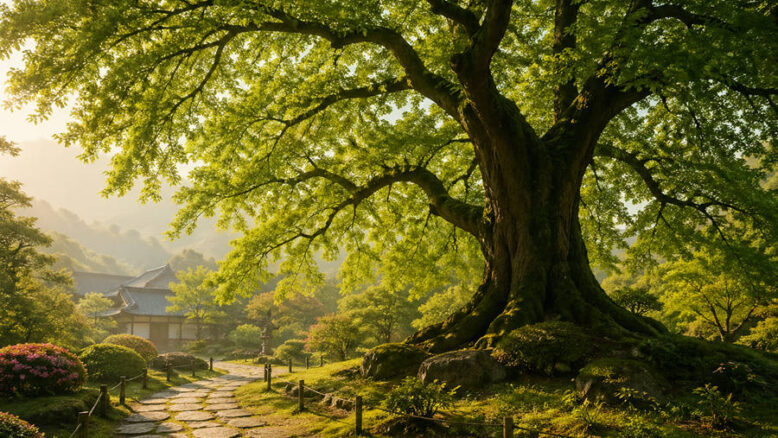
Tree names have a calm, grounded beauty. They can suggest roots, growth, patience, protection, and a close connection to nature. In Japanese names, tree-related meanings usually come from kanji such as 木, 樹, 林, 森, 葉, and 枝.
It is important to look at the Japanese writing, not only the sound of the name. The same reading can be written with different kanji, and each version may have a different meaning. In this guide, you’ll find names that directly mean “tree,” along with names inspired by leaves, forests, groves, branches, and specific trees.
What “Tree” Means in Japanese Names
The most direct kanji for “tree” is 木. It can mean tree or wood, and it appears in many Japanese words and family names. Another common tree-related kanji in given names is 樹, which also means tree. 樹 often feels graceful and strong because it can suggest a standing tree, something planted, or something firmly established.
Here are the main kanji to know when looking for Japanese names connected to trees:
- 木 — tree, wood
- 樹 — tree, standing tree
- 林 — woods, grove
- 森 — forest
- 葉 — leaf
- 枝 — branch
Names with these kanji can feel steady, fresh, poetic, or seasonal. A name with 樹 may feel strong and rooted. A name with 葉 may feel light and fresh. A name with 森 or 林 may bring to mind a peaceful forest or grove.
Japanese Girl Names That Mean Tree or Are Tree-Inspired
Itsuki — いつき / 樹
Japanese writing: いつき(樹)
Meaning: tree, standing tree
Itsuki is one of the clearest Japanese names connected to trees. Written as 樹, it directly means “tree.” It is often used for boys, but its simple sound and nature meaning can also work as a modern, gender-neutral choice. The name feels calm, strong, and clean.
Konoka — このか / 木乃香
Japanese writing: このか(木乃香)
Meaning: fragrance of trees, scent of wood
Konoka is a soft, poetic name choice. The phrase 木の香 can mean the scent of wood or the fragrance of trees. The kanji form 木乃香 gives the idea a more name-like style. This name feels gentle and natural, with an image of forest air, fresh wood, or a quiet garden.
Hazuki — はづき / 葉月
Japanese writing: はづき(葉月)
Meaning: leaf month
Hazuki is written with 葉, meaning “leaf,” and 月, meaning “moon” or “month.” 葉月 is also a traditional Japanese name for the eighth month of the old calendar. It does not literally mean “tree,” but it has a clear leafy and seasonal feeling. Hazuki is graceful, familiar, and nature-inspired.
Wakaba — わかば / 若葉
Japanese writing: わかば(若葉)
Meaning: young leaves
Wakaba means “young leaves.” It suggests freshness, youth, renewal, and spring growth. It is more of a nature word than a very common everyday given name, but it works beautifully for a poetic name, a character name, or a soft tree-inspired choice.
Kaede — かえで / 楓
Japanese writing: かえで(楓)
Meaning: maple
Kaede means “maple.” It is one of the most natural choices for a Japanese name based on a specific tree. The name has a warm, artistic feeling and is often associated with autumn color. Kaede is simple, elegant, and easy to connect with tree imagery.
Sakura — さくら / 桜
Japanese writing: さくら(桜)
Meaning: cherry blossom, cherry tree
Sakura is one of the best-known Japanese nature names. The kanji 桜 refers to cherry blossoms and can also refer to the cherry tree itself. Many people think first of the flower, but the name is still closely tied to the tree that blooms each spring. Sakura feels gentle, bright, and graceful.
Kiko — きこ / 木子
Japanese writing: きこ(木子)
Meaning: tree child
Kiko can be written with 木, meaning “tree,” and 子, meaning “child.” This creates the simple meaning “tree child.” However, 木子 is a very literal and uncommon kanji form for a Japanese given name. It is best treated as a rare or creative option rather than a typical traditional name.
Japanese Boy Names That Mean Tree or Are Tree-Inspired
Itsuki — いつき / 樹
Japanese writing: いつき(樹)
Meaning: tree
Itsuki is a strong and direct tree name when written as 樹. It has the image of a tree standing firmly in the earth. The name can suggest stability, growth, and quiet strength. Because it uses the kanji 樹 by itself, the tree meaning is clear.
Taiki — たいき / 大樹
Japanese writing: たいき(大樹)
Meaning: great tree
Taiki combines 大, meaning “big” or “great,” with 樹, meaning “tree.” Together, 大樹 means “great tree.” This is one of the strongest and most direct Japanese boy names connected to trees. It suggests deep roots, growth, and a broad, steady presence.
Naoki — なおき / 直樹
Japanese writing: なおき(直樹)
Meaning: upright tree, honest tree
Naoki is a classic masculine name. Written as 直樹, it combines 直, meaning “straight,” “direct,” or “honest,” with 樹, meaning “tree.” The name can be understood as “upright tree” or, more symbolically, “honest tree.” It feels dependable, grounded, and natural as a real Japanese given name.
Haruki — はるき / 春樹
Japanese writing: はるき(春樹)
Meaning: spring tree
Haruki can be written as 春樹, combining 春, meaning “spring,” with 樹, meaning “tree.” This gives the name the fresh meaning “spring tree.” It feels warm, hopeful, and literary. Haruki can be written with other kanji too, so the tree meaning applies specifically to 春樹.
Masaki — まさき / 正樹
Japanese writing: まさき(正樹)
Meaning: correct tree, righteous tree
Masaki written as 正樹 combines 正, meaning “correct,” “right,” or “proper,” with 樹, meaning “tree.” The meaning can be read in a symbolic way as “upright tree” or “righteous tree.” Masaki has a steady, traditional feeling.
Yūki — ゆうき / 優樹・悠樹
Japanese writing: ゆうき(優樹 / 悠樹)
Meaning: gentle tree / calm, spacious tree, depending on kanji
Yūki is a flexible name with many possible kanji. When written as 優樹, it combines 優, meaning “gentle,” “excellent,” or “kind,” with 樹, meaning “tree.” When written as 悠樹, it pairs 樹 with 悠, a kanji that can suggest calmness, distance, or a long, spacious feeling. Yūki only has a tree meaning when 樹 is part of the writing.
Shigeki — しげき / 茂樹
Japanese writing: しげき(茂樹)
Meaning: flourishing tree
Shigeki written as 茂樹 combines 茂, meaning “to grow thickly” or “to flourish,” with 樹, meaning “tree.” It brings to mind a tree full of leaves and life. The name has a strong, mature, and abundant feeling.
Unisex Japanese Names Connected to Trees
Itsuki — いつき / 樹
Japanese writing: いつき(樹)
Meaning: tree
Itsuki is one of the best tree-related names for a simple, modern sound. It is more common for boys, but it can also feel gender-neutral because of its clear nature meaning and soft ending.
Mizuki — みずき / 瑞樹・美樹
Japanese writing: みずき(瑞樹 / 美樹)
Meaning: auspicious tree / beautiful tree, depending on kanji
Mizuki is a lovely name with several possible writings. 瑞樹 can suggest an auspicious or fresh tree, while 美樹 means “beautiful tree.” The sound is soft and familiar, but the meaning depends completely on the chosen kanji.
Natsuki — なつき / 夏樹
Japanese writing: なつき(夏樹)
Meaning: summer tree
Natsuki written as 夏樹 combines 夏, meaning “summer,” with 樹, meaning “tree.” It gives the image of a tree in full summer growth. The name feels bright, warm, and seasonal.
Kazuki — かずき / 和樹・一樹
Japanese writing: かずき(和樹 / 一樹)
Meaning: harmonious tree / one tree, depending on kanji
Kazuki can be written in many ways. 和樹 may be read as “harmonious tree,” while 一樹 can mean “one tree.” Both versions feel calm and grounded. Kazuki is usually masculine, but its gentle sound and nature meaning can also suit fictional or gender-neutral naming.
Aoki — あおき / 青木
Japanese writing: あおき(青木)
Meaning: green tree, blue-green tree
Aoki is much more common as a surname than as a given name. It combines 青, which can mean blue, green, or blue-green, with 木, meaning “tree.” The name has a fresh, natural image, but readers should understand it mainly as a family name.
Japanese Last Names That Mean Tree
Kimura — きむら / 木村
Japanese writing: きむら(木村)
Meaning: tree village
Kimura is a common Japanese surname. It combines 木, meaning “tree,” with 村, meaning “village.” The meaning gives the name a rooted, rural, and natural image.
Aoki — あおき / 青木
Japanese writing: あおき(青木)
Meaning: green tree, blue-green tree
Aoki combines 青 with 木. In Japanese, 青 can refer to blue, green, or blue-green depending on context. With 木, the name suggests a fresh green tree or blue-green tree.
Takagi — たかぎ / 高木
Japanese writing: たかぎ(高木)
Meaning: tall tree
Takagi is written with 高, meaning “tall” or “high,” and 木, meaning “tree.” The name has a clear upright image, like a tall tree rising above the ground.
Hayashi — はやし / 林
Japanese writing: はやし(林)
Meaning: woods, grove
Hayashi is written with 林, meaning “woods” or “grove.” It is one of the clearest Japanese surnames connected to a group of trees rather than a single tree.
Moriki — もりき / 森木
Japanese writing: もりき(森木)
Meaning: forest tree
Moriki combines 森, meaning “forest,” with 木, meaning “tree.” It has a strong woodland image. It is less familiar than surnames like Kimura, Aoki, or Hayashi, but the kanji meaning is easy to understand.
Ueki — うえき / 植木
Japanese writing: うえき(植木)
Meaning: planted tree, garden tree
Ueki combines 植, meaning “to plant,” with 木, meaning “tree.” The word 植木 can refer to a planted tree, garden tree, or ornamental tree. As a surname, it has a clear connection to gardens, trees, and cultivation.
Tree Names Based on Specific Trees in Japanese
Sakura — さくら / 桜
Japanese writing: さくら(桜)
Meaning: cherry blossom, cherry tree
Sakura is strongly tied to spring in Japan. It usually brings cherry blossoms to mind first, but 桜 can also refer to the cherry tree. This makes Sakura both a flower name and a tree-inspired name.
Kaede — かえで / 楓
Japanese writing: かえで(楓)
Meaning: maple
Kaede means maple. It is one of the most name-friendly choices among Japanese tree words. The name has a warm autumn feeling and works well for readers who want a natural name that is not too literal.
Matsu — まつ / 松
Japanese writing: まつ(松)
Meaning: pine
Matsu means pine. Pine trees are often linked with endurance and long life in Japanese symbolism. Matsu appears often in surnames, place names, and traditional imagery. As a personal name, it feels more old-fashioned or word-like.
Sugi — すぎ / 杉
Japanese writing: すぎ(杉)
Meaning: Japanese cedar
Sugi means Japanese cedar. It has a tall, strong, forest-like image. Like Matsu, it is more common as a tree word or surname element than as a modern given name.
Kiri — きり / 桐
Japanese writing: きり(桐)
Meaning: paulownia
Kiri means paulownia when written as 桐. The paulownia tree appears in Japanese patterns and traditional symbols. The sound Kiri can be written with other kanji too, so the tree meaning applies only to 桐.
Hinoki — ひのき / 檜・桧
Japanese writing: ひのき(檜 / 桧)
Meaning: Japanese cypress
Hinoki means Japanese cypress. It is associated with fragrant wood, baths, temples, and traditional architecture. Hinoki sounds elegant, but it is usually understood more as a tree word than as a common personal name.
Names With Tree, Leaf, Branch, or Forest Meanings
Tree-related names do not all use the same kind of imagery. Some refer directly to trees, while others point to leaves, forests, branches, or flowering trees. This can help you choose a name with the right feeling.
Tree Names
- Itsuki — いつき(樹): tree
- Taiki — たいき(大樹): great tree
- Naoki — なおき(直樹): upright tree, honest tree
- Haruki — はるき(春樹): spring tree
Leaf Names
- Wakaba — わかば(若葉): young leaves
- Hazuki — はづき(葉月): leaf month
- Aoba — あおば(青葉): green leaves, fresh leaves
Forest and Grove Names
- Hayashi — はやし(林): woods, grove
- Mori — もり(森): forest
- Morika — もりか(森香): forest fragrance, a creative name-like combination
Branch Names
- Eda — えだ(枝): branch
- Edako — えだこ(枝子): branch child, a rare or creative combination
Flowering Tree Names
- Sakura — さくら(桜): cherry blossom, cherry tree
- Kaede — かえで(楓): maple
For real-life naming, names such as Itsuki, Taiki, Naoki, Haruki, Mizuki, Natsuki, Kazuki, Sakura, and Kaede feel more natural than very literal combinations like Edako or Kiko written as 木子. For stories, games, or symbolic naming, creative forms can still work well when the kanji meaning is clear.
Final Thoughts
Japanese names that mean tree can feel strong, peaceful, seasonal, or poetic depending on the kanji. The most direct kanji are 木 and 樹. Names such as Itsuki, Taiki, Naoki, and Haruki use 樹 for a clear tree-related meaning. Names such as Sakura, Kaede, Wakaba, and Hazuki bring in cherry trees, maple trees, leaves, and seasonal nature.
If you want the clearest “tree” meaning, look for names written with 樹 or 木. If you prefer a softer nature feeling, names using 葉, 林, 森, 桜, or 楓 may be a better fit. These names can carry lovely images of roots, growth, patience, renewal, and a quiet connection to the natural world.