
Japanese names that mean star have a special kind of beauty. Some use kanji that mean star in a direct way, while others suggest starlight, a starry sky, a shooting star, or even a famous star cluster. That gives this theme a lot of range. You can find names that feel soft, elegant, rare, dreamy, or strong, depending on the kanji and reading. In this guide, you will find the meanings behind Japanese star names, the main kanji connected to them, and the best ideas for girls, boys, and more poetic celestial styles.
What Makes a Japanese Name Mean “Star”?
A Japanese name usually feels star-related for one of two reasons. It either uses a kanji that directly means star, or it uses kanji and wording that create a clear star image. The most direct route is 星, which is the standard Japanese word for a star. Names built around this character are the clearest fit for anyone searching for Japanese names that mean star.
That said, not every beautiful celestial name means star in the same exact way. Some names are literal and easy to explain because the kanji itself carries the meaning of star. Others are more poetic. They may suggest starlight, a sky filled with stars, a meteor, or a famous cluster such as the Pleiades. Both styles belong in this theme, but they do different jobs. A literal star name feels clear and direct. A poetic star name feels softer, more image-based, and sometimes more unique.
This is also why kanji matters more than sound alone. In Japanese names, the same pronunciation can be written with different characters, and those characters can completely change the meaning. A name may sound bright or elegant, but the real meaning depends on how it is written. That is why the best way to understand a Japanese star name is to look at both the reading and the kanji together.
For this article, the strongest star names fall into two main groups. The first includes names that use a direct star kanji such as 星. The second includes names with a strong and established star image, such as 流星 for a shooting star, 星空 for a starry sky, or 昴 for the Pleiades. Keeping that standard in place helps this topic stay clear and useful instead of drifting into every possible sky or light name.
The Main Kanji and Words Behind Japanese Star Names
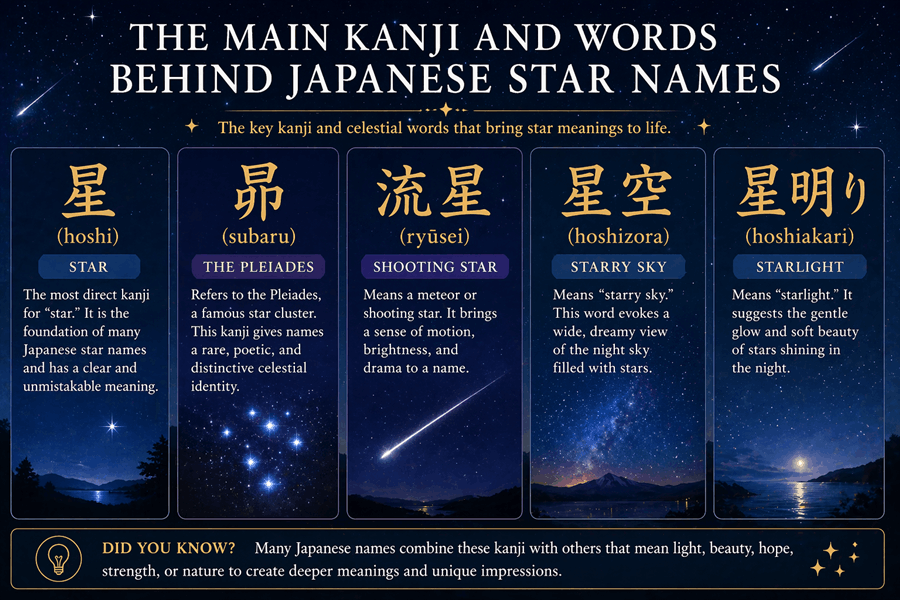
The heart of this theme is not just the sound of a name, but the exact kanji and star-related words behind it. Once you understand the core characters, the whole category becomes much easier to sort. You can see which names are truly direct, which ones are poetic, and which ones are inspired by constellations or celestial scenes.
星 — the clearest kanji for “star”
The most direct kanji in this category is 星. It is the strongest foundation for names that clearly and literally mean star. Names built from 星 feel bright, simple, and unmistakably celestial. This is the character most readers will want to focus on if they want a true star meaning rather than a looser night-sky feeling.
昴 — a rare and distinctive star-cluster kanji
昴, often read Subaru, is one of the most striking kanji in this theme. It refers to the Pleiades, a famous star cluster. That gives it a very special place in Japanese star naming. It is not a general word for star. It points to a specific group of stars, which makes names built around it feel rarer, more poetic, and more memorable.
流星 — the image of a shooting star
流星, read Ryūsei or Ryuusei, means a shooting star or meteor. This word brings motion into the theme. Compared with calmer star names, it feels more vivid, dramatic, and energetic. It is one of the best examples of a star-related name that still feels strong and highly expressive.
星空, 星明り, and other poetic star imagery
Some of the most beautiful star-related name ideas come from poetic expressions rather than a single kanji. 星空 means a starry sky. 星明り means starlight. These kinds of words show how Japanese star imagery expands beyond the simple meaning of star into atmosphere, softness, and visual beauty. Even when the exact full expression is not used as a common given name, it still influences the feeling of many star-inspired names.
There is also one practical detail worth keeping in mind. In Japan, legal name kanji come from approved character sets used for names. So when people explore beautiful name ideas, the strongest options are the ones that are not only meaningful and attractive, but also workable as real name kanji.
Best Japanese Names That Mean Star
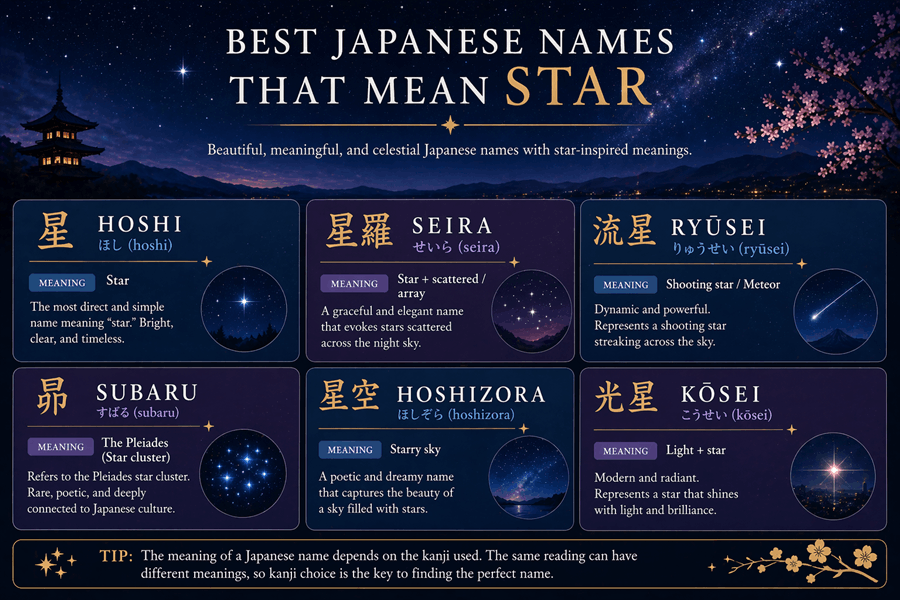
When you look at the best Japanese names that mean star, one thing becomes clear right away: there is no single style. Some names are very direct. Others feel modern, soft, bold, or poetic depending on the kanji paired with the star element. That variety is exactly what makes this topic so rich.
Direct star names
Hoshi written as 星 is the clearest direct option. It is simple, bright, and easy to understand. If someone wants a name that truly means star without any extra explanation, this is one of the strongest choices in the entire category.
Sei and Seira are also strong star-related names because they stay close to the core meaning while sounding lighter and more stylized than plain Hoshi. These kinds of names show how Japanese naming can take one simple idea and shape it into something more elegant or modern through reading and pairing.
Poetic and image-based star names
Some names feel more beautiful because they move beyond the plain meaning of star and build a whole image around it. Hoshizora written as 星空 is a great example. Instead of pointing to one star, it suggests a sky filled with stars. That gives the name a dreamy, open, and romantic feeling.
Ryūsei works in a different way. Because it means shooting star, it adds motion and energy to the theme. It feels brighter and more dramatic than a calm direct-star name, which is why it stands out so strongly in this category.
Modern star names
Kōsei or Kousei is one of the strongest modern-feeling names in the star category. It appears in star-centered forms such as 光星, 輝星, and 煌星. These pairings connect star with light, radiance, or brilliance. The result is a name that feels polished, current, and energetic while still keeping the star meaning visible.
This is one of the most useful patterns in Japanese star naming. A name can keep the celestial core of 星 while letting the second kanji shape the mood. That mood might be softer, brighter, bolder, rarer, or more refined depending on the pairing.
Japanese Names That Mean Starlight, Starry Sky, or Shooting Star
Some of the most beautiful Japanese star names are not plain one-word star names at all. Instead, they grow out of star imagery. This is where the theme becomes softer and more expressive. It also becomes more emotional, because the focus shifts from a simple object in the sky to the feeling created by that object.
Names inspired by starlight
Starlight names usually feel gentle, luminous, and elegant. Instead of naming the star itself, they suggest the glow that comes from it. This gives them a calmer and more atmospheric feeling. These names often work well for readers who want something pretty and celestial without sounding too plain or too sharp.
A good example of this style is a name that combines 星 with a kanji for light, brilliance, or glow. That kind of pairing often feels more delicate than a direct star name while still keeping the meaning close to the night sky.
Names inspired by a starry sky
Starry-sky names feel wider and dreamier. They suggest a full scene rather than a single point of light. Hoshizora is the clearest example here. It is more poetic than practical, but that is exactly why it is memorable. It creates a mood right away. For readers who care about beauty, atmosphere, and imagery, this type of name can feel even more appealing than a straightforward star name.
Names inspired by shooting stars
Shooting-star names feel more vivid and powerful. Ryūsei is the strongest example because it carries the image of speed, motion, and brightness all at once. Compared with calm star or starlight names, this branch feels more energetic and more dramatic. It is especially attractive for readers who want a name that sounds bold or full of life.
These names still belong under the star theme because the star image remains central. They are simply more descriptive and image-driven than plain direct-star names.
Beautiful Japanese Girl Names That Mean Star
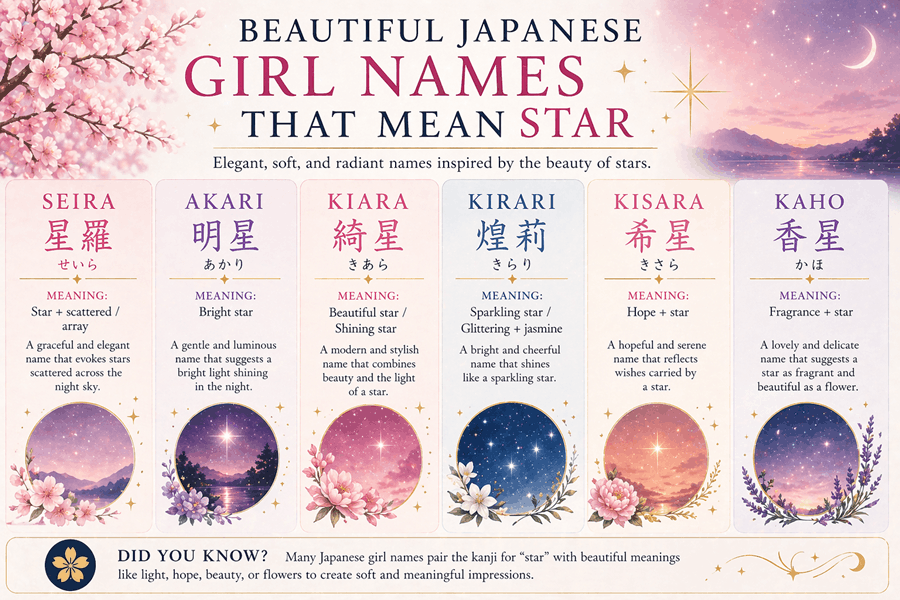
Japanese girl names that mean star often feel softer and more image-driven than the plain literal word Hoshi. Many of the prettiest options keep the star meaning clear while pairing it with ideas like beauty, brightness, fragrance, flowers, or grace. That is what gives this part of the category its gentle and elegant feel.
Soft and elegant girl names
Seira is one of the prettiest star-related girl names because it sounds light and graceful while still staying close to the celestial theme. It has a soft modern feel without losing the simple beauty that makes star names so appealing.
Akari is another lovely option in star-related forms because it naturally carries a bright and gentle feeling. When paired with star-centered kanji, it can suggest ideas such as bright star, beautiful star, or star light. That makes it a strong choice for readers who want something feminine, soft, and luminous.
Cute and modern girl names
Names like Kiara, Kirari, and Kisara feel especially modern because they pair the star meaning with shine, sparkle, or visual brightness. These names often sound lively, stylish, and expressive. Instead of feeling plain, they give the star theme a fresh and fashionable edge.
Kaho is another good example of how flexible this category can be. Depending on the kanji pairing, it can take on a sweeter, more seasonal, more floral, or more radiant feeling while still keeping the star image close at hand.
Rare and poetic girl names
Some star-related girl names feel rare because they blend star imagery with ideas like hope, calmness, rarity, or sky scenery. These names are especially attractive for readers who want something dreamy and less expected. They may not be the most direct star names in the category, but they often feel richer in mood and more distinctive in style.
That is one of the biggest strengths of Japanese girl names in this theme. They can stay clearly celestial while still feeling elegant, decorative, and emotionally layered.
Strong Japanese Boy Names That Mean Star
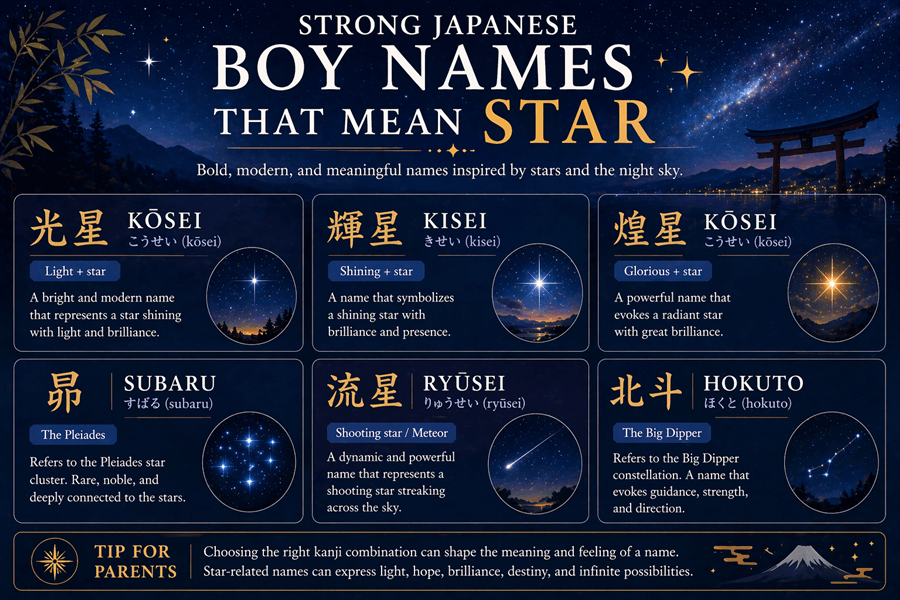
Japanese boy names that mean star often feel sharper, brighter, and more forceful than the softer girl-name examples. Many of them keep the meaning close to an actual star, but the second kanji can add ideas like brilliance, depth, luck, scale, or strength. That creates a group of names that feel masculine without losing the beauty of the celestial theme.
Cool and modern boy names
Kōsei is one of the best modern-feeling boy names in this category. Forms such as 光星, 輝星, and 煌星 connect the star image with light and radiance, giving the name a sleek and polished feeling. It sounds current, but it still feels grounded in a strong meaning.
Yūki or Yuuki can also take star-related forms that feel balanced and appealing. Instead of sounding intense, this kind of name often feels warm and quietly strong, which gives it a different style from bolder star names.
Bold celestial boy names
Subaru is one of the strongest names in the entire star theme. Its connection to 昴, the Pleiades, gives it a very distinctive identity. It feels classic, celestial, and memorable. This is not just a general star name. It is tied to a specific and well-known star cluster, which gives it real depth.
Ryūsei is another standout. Because it means shooting star, it adds motion and force to the name. It feels vivid, bold, and dramatic. For readers who want a boy name that sounds energetic and high-impact, it is one of the best choices in the whole category.
Rare and high-impact boy names
Some boy names feel especially strong because they pair 星 with kanji that add scale, status, or emotional weight. A star name can feel noble, expansive, lucky, or brilliant depending on the second character. This is where the category becomes especially interesting. The same basic celestial meaning can lead to very different results.
That range is what makes Japanese boy names that mean star so useful. Some are clean and modern. Some are bold and dramatic. Some feel rare and literary. All of them show how much personality a name can gain just from one carefully chosen kanji pairing.
Rare Japanese Names Inspired by Stars and Constellations
Rare Japanese star names become even more interesting when they move beyond the plain meaning of 星 and draw from a specific cluster, constellation image, or named star. This is where the theme starts to feel more distinctive and more symbolic.
Pleiades-inspired names
The clearest example here is Subaru. Because 昴 refers to the Pleiades, the name carries a very specific celestial image rather than a vague sky feeling. That alone makes it feel more refined and memorable than many broader star names.
Names built around 昴 can also become rarer and more artistic when paired with other kanji. These combinations often feel elevated and literary. They keep the same star-cluster meaning while adding new layers such as brilliance, life, or flow.
North Star and Big Dipper names
Hokusei written as 北星 and Hokuto written as 北斗 are some of the strongest names in this subcategory. They feel cooler, more directional, and more structured than softer star names. That is part of what makes them so appealing.
These names also carry a feeling of guidance and steadiness because of their northern sky associations. Instead of simply meaning star, they suggest orientation, constellations, and a stronger sense of place in the sky.
Tanabata-inspired star imagery
Some of the most poetic star inspiration in Japanese culture comes from Tanabata. The story of Altair and Vega adds romance, longing, and summer-night sky beauty to the broader star theme. Even when these references are not used as common everyday baby names, they still enrich the article because they show how deeply stars are woven into Japanese seasonal and cultural imagery.
This matters because not every rare star-inspired name has to come from a plain database entry. Some are valuable because they expand the imagination of the theme. They help readers see that Japanese star names are not only about literal meanings. They are also about story, image, and atmosphere.
How to Choose the Right Japanese Star Name
Choosing a Japanese star name is not only about finding something that sounds beautiful. The better choice usually comes from matching the name’s meaning, image, and reading to the feeling you want. That is especially important in this theme, because some names are literal and clear while others are soft, poetic, or highly specialized.
Choose between literal and poetic
If you want the meaning to be obvious and easy to explain, a direct star name built around 星 is usually the best fit. If you want something more atmospheric, a name inspired by starlight, a starry sky, or a constellation may feel more special. Neither style is better. They simply create different impressions.
Think about the feeling of the name
Star names can still feel very different from one another. Some feel bright and elegant. Some feel dreamy and romantic. Others feel cool, bold, or dramatic. The second kanji often shapes that mood. A star paired with light, beauty, hope, sound, or motion will feel very different from a star paired with strength or direction.
Check the kanji carefully
A name may sound lovely when spoken, but the real meaning depends on the kanji used to write it. This is one of the most important parts of choosing a Japanese name. It is also why a careful, kanji-first approach works so well for star names. The sound alone cannot tell the full story.
Consider readability
Some names look beautiful in kanji but have readings that may be harder for others to guess. Others feel easier to understand and use in everyday life. That does not mean unusual readings are bad. It simply means readability is worth thinking about if you want a name that feels practical as well as meaningful.
Modern or classic?
Some Japanese star names feel modern because they sound sleek and bright. Others feel classic because they connect to older celestial language, traditional sky imagery, or well-known star clusters. Deciding which tone you prefer can make the whole process easier.
In the end, the right Japanese star name is the one that balances three things well: a meaning you truly like, kanji that support that meaning clearly, and a reading that feels natural for the style you want.
Are All Celestial Japanese Names Also Star Names?
No, and this distinction matters. A celestial Japanese name may relate to the sky, moon, night, light, or the heavens in a broad sense, but that does not automatically make it a true star name. This is where many articles get too loose. They start with stars, then slowly turn into general sky names.
Moon names, sky names, night names, and light names may feel very close to star names, but they are not identical. A name built from 月 is moon-themed, not star-themed. A name built from 空 may suggest sky or openness, but it is not automatically a star name unless the star image is still central. A light-themed name can feel luminous without saying where that light comes from.
That is why this article defines a true star name as one with a direct star kanji such as 星, or one with a strong and recognized star-based image such as 流星, 星空, or 昴. Keeping that boundary in place makes the category more accurate, more useful, and much more trustworthy.
Our Favorite Japanese Names That Mean Star
After looking across the whole category, a few names stand out more than others because each one represents a different strength.
- Hoshi — the clearest direct star name
- Seira — one of the prettiest soft and feminine choices
- Ryūsei — the strongest bold and high-energy choice
- Subaru — the best constellation-inspired star name
- Hoshizora — the most poetic and image-rich option
- Kōsei — one of the best modern star names
What makes this shortlist useful is that it does not rely on only one kind of beauty. Hoshi wins on clarity. Seira feels light and elegant. Ryūsei brings motion and power. Subaru adds celestial depth through the Pleiades. Hoshizora brings atmosphere and wonder. Kōsei gives the theme a modern edge. Together, they show just how flexible Japanese star naming can be.
Final Thoughts on Japanese Names That Mean Star
Japanese names that mean star can be simple, poetic, bright, or deeply symbolic. Some stay very close to the direct meaning of 星, while others branch into richer images such as a shooting star, a starry sky, or a famous cluster like the Pleiades. That range is what makes this theme so appealing. It gives you names that feel clear and literal, but also names that feel dreamy, rare, and full of atmosphere.
The best choice usually comes down to the feeling you want most. If you want something clean and unmistakable, a direct star name works best. If you want something softer or more artistic, a name inspired by starlight, constellations, or a celestial scene may feel more special. Either way, Japanese star names have a beauty that is hard to miss. They carry light, wonder, and quiet meaning, which is exactly why they remain one of the most attractive name themes to explore.
As a whole, this topic shows just how rich Japanese name meanings can be. A single star image can become elegant, bold, rare, modern, or romantic depending on the kanji and reading you choose. That is what makes Japanese names that mean star more than just pretty celestial ideas. They become names with mood, imagery, and real depth.