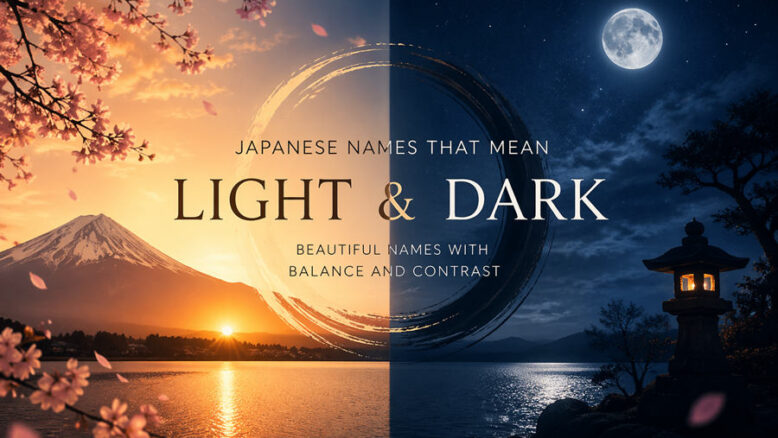
Some Japanese names feel especially beautiful because they hold contrast so well. A name can suggest brightness and shadow at once through images like dawn, moonlight, sunset, or a small glow in the night. In Japanese naming, this usually comes through kanji, mood, and symbolism rather than one exact phrase that literally means “light and dark.” That is what makes these names so appealing. They can feel balanced, poetic, calm, and full of depth without sounding forced or overly dramatic.
What “Light and Dark” Can Mean in Japanese Names
When readers search for Japanese names that mean light and dark, they are usually not looking for a harsh or literal contrast. More often, they want a name that feels balanced, layered, or quietly powerful. In Japanese, that kind of meaning often comes through the image behind the name rather than a simple dictionary definition.
In practice, this theme usually appears in three main ways:
- Direct meaning: the kanji relate clearly to light, brightness, moon, night, dawn, or evening.
- Transitional meaning: the name suggests a meeting point between darkness and light, such as sunrise or twilight.
- Symbolic fit: the name evokes contrast, stillness, mystery, warmth, or inner balance.
That distinction is important because Japanese names do not work like fixed labels. The same sound can be written with different kanji, and each spelling can shift the meaning. So while very few names literally mean “light and dark,” many names can express that feeling beautifully.
Common Japanese Kanji Linked to Light
Many names in this theme begin with kanji associated with brightness, radiance, and warmth. These are some of the most common elements readers will see:
- 光 — light, radiance
- 明 — bright, clear
- 陽 — sun, sunlight, warmth
- 旭 — rising sun, morning light
- 輝 — brilliance, shine
- 灯 — lamp, light
Names built from these kanji often feel open, lively, and hopeful. Still, in a light-and-dark theme, they are often most striking when paired with softer or quieter imagery. A small lamp, a first light, or a moonlit glow can feel more balanced than brightness alone.
Common Japanese Kanji Linked to Night, Shadow, and Darkness
The darker side of this theme is usually more subtle. In Japanese names, “dark” often shows up through ideas like night, moonlight, shadow, or evening rather than blunt or severe darkness.
- 夜 — night
- 月 — moon
- 影 — shadow, silhouette
- 夕 — evening
- 暁 — dawn, daybreak
It is also worth being careful with darker kanji. Some characters that literally mean darkness can feel heavy and are not especially natural in personal names. That is why names tied to moonlight, evening, or dawn are often a better fit for readers who want this contrast in a graceful, usable way.
Why Dawn, Dusk, and Moonlight Fit This Theme Best
The strongest Japanese names in this category usually do not force two opposites into a single literal meaning. Instead, they capture the moment where one becomes the other. Dawn, dusk, moonlight, sunset, firelight, and the night sky all naturally hold both brightness and shadow at once.
That is what makes these images so powerful in naming. They do not feel split or contradictory. They feel complete. A name tied to moonlight can feel gentle but luminous. A name tied to dawn can feel hopeful without losing depth. A name tied to evening can feel soft, reflective, and emotionally rich.
Beautiful Japanese Girl Names With Light and Dark Symbolism
These names work especially well for readers who want something soft, poetic, and balanced. Some are direct fits, while others are stronger as symbolic matches.
Hotaru
Reading: Hotaru
Common association: firefly
Why it fits: This is one of the clearest symbolic matches for light and dark. A firefly is a small living light in the night, so the image naturally combines brightness with darkness.
Note: This is best understood through imagery rather than as a literal “light and dark” name.
Tsukiko
Reading: Tsukiko
Common association: moon child, depending on kanji
Why it fits: Moonlight is one of the most elegant ways to express brightness within darkness. Tsukiko feels gentle, feminine, and quietly luminous.
Note: Its exact meaning depends on the kanji used, but moon-based readings are a strong fit for this theme.
Mizuki
Reading: Mizuki
Meaning: varies by kanji
Why it fits: Mizuki is a good example of why kanji matter. Some spellings are not related to light or dark at all, while moon-based writings can give it a calm, moonlit feeling that suits this theme well.
Note: Best treated as a possible fit, not a guaranteed one.
Kagari
Reading: Kagari
Common association: bonfire, beacon fire
Why it fits: Kagari suggests warmth and visible light against darkness. It feels stronger and more dramatic than some of the softer names on this list.
Note: This reads as a poetic or uncommon choice rather than a mainstream everyday given name.
Yūhi
Reading: Yuuhi or Yūhi
Common association: evening sun, sunset imagery
Why it fits: Sunset naturally combines fading light with the coming dark. It gives this name a warm but reflective mood.
Note: It works especially well for readers who love twilight imagery.
Yozora
Reading: Yozora
Common meaning: night sky
Why it fits: The night sky carries darkness, but it also implies moonlight, stars, and quiet beauty. That makes Yozora a strong symbolic fit for this theme.
Note: It feels modern and poetic, and is less traditional as a given name than some other choices here.
Japanese Boy Names With Light and Dark Symbolism
Boy names in this theme often lean toward dawn, sunrise, moonlight, or clear radiance emerging from shadow.
Akatsuki
Reading: Akatsuki
Common meaning: dawn, daybreak
Why it fits: This is one of the best examples of a true in-between image. Dawn is the moment when darkness begins to break and light begins to rise.
Note: It is a powerful, atmospheric choice and feels more poetic than plain.
Asahi
Reading: Asahi
Common meaning: morning sun
Why it fits: Asahi points to first light rather than full daylight. That gives it a softer and more transitional quality, which fits the light-and-dark theme better than a name tied only to midday brightness.
Akira
Reading: Akira
Common meaning: often bright, clear, or shining, depending on kanji
Why it fits: Akira is mainly a light-based name, but it works well in this theme when the goal is clarity with depth. It feels polished and balanced rather than overly bright.
Note: This is a subtler fit than dawn- or moon-based names.
Hikaru
Reading: Hikaru
Common meaning: shine, radiance, light
Why it fits: Hikaru is directly linked to light. It suits this theme best when the reader wants the idea of brightness standing out against shadow rather than a literal mix of opposites.
Note: Stronger on the “light” side than the “dark” side.
Tsukito
Reading: Tsukito
Meaning: varies by kanji; moon-related writings are possible
Why it fits: With the right kanji, Tsukito can carry a calm nighttime glow. It feels quieter and more reflective than sun-based options.
Note: As with many Japanese names, the sound alone does not guarantee the meaning.
Unisex Japanese Names With a Light-and-Dark Feel
Some names work well across styles because they feel balanced rather than strongly gendered. These are especially appealing for readers who want a modern, flexible choice.
Mizuki
Mizuki remains one of the most versatile options in this theme because it can feel modern, gentle, and moonlit when written with suitable kanji.
Akira
Akira has a clean and timeless quality. It leans bright in meaning, but its restrained tone gives it more depth than a purely sunny name.
Hikaru
Hikaru is clear, luminous, and familiar. It is a stronger fit for readers who want radiance with a calm mood rather than overt darkness.
Yozora
Yozora is a more artistic option. It feels atmospheric and modern, making it a good choice for readers drawn to names with strong imagery.
How to Choose the Right Name for This Theme
If you want a Japanese name that captures both light and dark, it helps to decide what matters most to you.
- Choose a direct fit if you want kanji clearly linked to dawn, moon, light, or evening.
- Choose a symbolic fit if you care more about mood, imagery, and emotional tone.
- Check the kanji carefully because pronunciation alone does not fix the meaning.
- Think about balance by asking whether you want the name to feel warm, mysterious, calm, dramatic, or quietly luminous.
- Be cautious with literal darkness because some darker characters are less natural in everyday personal names.
For most readers, the most beautiful options are names tied to dawn, twilight, moonlight, sunset, lantern light, or the night sky. These images feel balanced and expressive without becoming too heavy.
Final Thoughts on Japanese Names That Mean Light and Dark
The best Japanese names in this category rarely come from a strict literal translation. Instead, they express the relationship between brightness and shadow in a more natural way. That may be the first light of dawn, the quiet glow of the moon, the warmth of a fire in the dark, or the still beauty of the evening sky.
Names like Akatsuki, Tsukiko, Hotaru, Asahi, and Yūhi show why this theme is so appealing. They do not just describe light or darkness on their own. They capture contrast, transition, and depth. If that is the feeling you want, a poetic balance will usually serve you better than a name that tries to be overly literal.