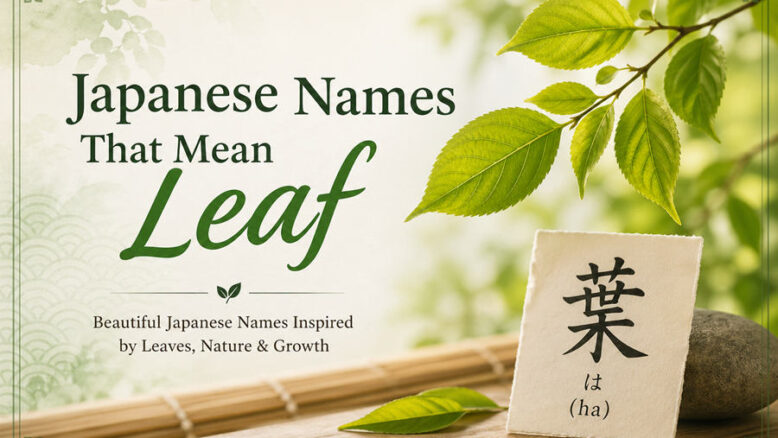
Japanese names that mean leaf often feel gentle, fresh, and close to nature. They can bring to mind young spring leaves, deep summer greenery, autumn colors, or the quiet sound of leaves moving in the wind. The most direct kanji for “leaf” is 葉, which can appear in given names, surnames, and nature words.
As with many Japanese names, the meaning depends on the kanji, not just the sound. A name may sound simple in English, but its Japanese writing can change the meaning completely. The names below include kanji, hiragana readings, and clear meaning notes so you can understand which names directly mean “leaf” and which are more loosely leaf-inspired.
What “Leaf” Means in Japanese Names
The main kanji for “leaf” is 葉. It can refer to a leaf, foliage, or a leaf-like part of a plant. In names, 葉 often gives a soft natural feeling connected to growth, freshness, seasons, and quiet beauty.
葉 is commonly associated with readings such as ha, ba, and yō, though Japanese name readings can be flexible. This is why the written form matters. A name that sounds like Yō, Hana, or Aoba may have a leaf meaning only when it uses the right kanji.
Leaf names often suggest renewal, youth, gentleness, calm strength, and a close connection to plants or trees. Some names use 葉 directly, while others use related kanji for buds, greenery, trees, or forests.
Japanese Girl Names That Mean Leaf
Many Japanese leaf names have a soft and graceful sound, which makes them especially appealing for girls. Some are familiar name forms, while others are better understood as creative or character-friendly options. The Japanese writing is included for each name because the meaning depends on the kanji.
Yōko — 葉子(ようこ)
Yōko can be written as 葉子. The kanji 葉 means “leaf,” while 子 means “child” and is a classic ending in many Japanese girls’ names.
With this writing, Yōko can be understood as “leaf child.” It has a traditional, gentle feeling, while the 葉 character adds a calm nature image. Because Yōko can be written with many other kanji, the leaf meaning applies specifically to the spelling 葉子.
Hano — 葉乃(はの)
Hano can be written as 葉乃. The first kanji, 葉, means “leaf,” while 乃 is a classical-looking character often used in names for its soft visual style.
Hano has a light, delicate sound. It feels more modern and poetic than traditional, making it a lovely choice for a nature-inspired character name or a creative name idea.
Haya — 葉也 / 葉弥(はや)
Haya may be written with the leaf kanji in forms such as 葉也 or 葉弥. In both versions, 葉 gives the name its leaf imagery, while the second kanji changes the nuance.
This name feels short, fresh, and easy to say. Because Haya can be written in different ways, it should not be translated as “leaf” unless the kanji 葉 is actually used.
Wakaba — 若葉(わかば)
Wakaba is one of the clearest Japanese names connected to leaves. It is written 若葉, combining 若 meaning “young” with 葉 meaning “leaf.”
The meaning is “young leaf” or “fresh new leaves.” Wakaba has a bright spring feeling and suggests youth, renewal, hope, and new beginnings. It is a beautiful option for readers who want a direct leaf meaning with a soft, positive image.
Aoba — 青葉(あおば)
Aoba is written 青葉. The kanji 青 can mean blue or green depending on context, and 葉 means “leaf.” Together, 青葉 means “green leaves” or “fresh foliage.”
Aoba feels vivid and clean, like leaves after rain or greenery in early summer. It can be used with a feminine, masculine, or gender-neutral feeling depending on context, but its sound is gentle enough to fit beautifully among girl names.
Futaba — 双葉(ふたば)
Futaba is written 双葉. The kanji 双 means “pair” or “two,” and 葉 means “leaf.” The word often refers to the first pair of leaves that appear from a young sprout.
Futaba has a sweet and hopeful image. It suggests small beginnings, early growth, and life just starting to open. It is one of the most charming leaf-related names for readers who like soft, youthful nature names.
Hana — 葉菜(はな)
Hana is often written as 花, meaning “flower,” but a leaf-inspired version can be written as 葉菜. In this form, 葉 means “leaf,” and 菜 refers to greens or vegetable plants.
The 葉菜 spelling gives Hana a leafy, plant-inspired meaning rather than a flower meaning. This is an important difference because the pronunciation may be the same, but the kanji changes the image completely.
Japanese Boy Names That Mean Leaf
Leaf names are often gentle, but they can also feel grounded and strong. For boys, the leaf kanji may be paired with characters that suggest a person, greatness, brightness, or steadiness.
Yō — 葉(よう)
Yō can be written simply as 葉, using the kanji for “leaf” by itself.
This name is short, clean, and direct. It has a calm natural feeling without sounding overly decorative. Because 葉 has more than one possible reading, the intended pronunciation should be made clear when using it as a name.
Hayato — 葉人(はやと)
Hayato can be written as 葉人. The kanji 葉 means “leaf,” and 人 means “person.”
This spelling can suggest “a person connected with leaves” or simply a nature-inspired person name. Hayato is a familiar masculine-sounding Japanese name, while the 葉人 writing gives it a fresh botanical touch.
Yōta — 葉太(ようた)
Yōta may be written as 葉太. The first kanji, 葉, means “leaf,” while 太 is often used in boys’ names and can suggest something big, broad, or strong.
This combination balances softness and strength. The leaf kanji gives the name a natural image, while 太 adds warmth and sturdiness. As with many Japanese names, Yōta has other possible spellings, so the leaf meaning depends on using 葉.
Aoba — 青葉(あおば)
Aoba, written 青葉, can also work well as a boy name. Its meaning, “green leaves” or “fresh foliage,” feels open, bright, and outdoorsy.
For a boy, Aoba may suggest calm energy, freshness, and quiet strength. It is also easy to understand visually, which makes it a strong choice for a character name.
Konoha — 木の葉 / 木葉(このは)
Konoha is closely connected to the Japanese word 木の葉, meaning “tree leaves.” It may also be styled as 木葉.
As a personal name, Konoha feels poetic and story-like. It is especially useful for fictional characters, pen names, or symbolic names. Since 木の葉 is also an ordinary word, it may feel more like a creative nature name than a typical everyday given name.
Gender-Neutral Japanese Names That Mean Leaf
Some Japanese leaf names do not feel strongly tied to one gender. They can work for boys, girls, or fictional characters of any gender depending on the kanji, sound, and setting.
Hazuki — 葉月(はづき)
Hazuki is written 葉月. The kanji are 葉, meaning “leaf,” and 月, meaning “moon” or “month.”
Hazuki is also a traditional Japanese name for the eighth month of the old calendar. Its origin is often explained through seasonal ideas related to leaves, so it should not be reduced only to “leaf moon.” As a personal name, Hazuki feels graceful, seasonal, and quietly poetic.
Aoba — 青葉(あおば)
Aoba is one of the most flexible leaf names. Written 青葉, it means “green leaves” or “fresh foliage.”
The name feels natural without being too formal. It suits readers who want a clear leaf meaning with a bright, peaceful image.
Wakaba — 若葉(わかば)
Wakaba, written 若葉, means “young leaf” or “young leaves.”
Although it often has a soft feeling, the meaning itself is not limited to one gender. It suggests renewal, growth, and the start of something hopeful.
Futaba — 双葉(ふたば)
Futaba is written 双葉, meaning “two leaves” or “a pair of young leaves.”
The image is small but powerful: the first leaves of a new plant. Futaba can symbolize potential, innocence, and early growth, making it a gentle but meaningful gender-neutral option.
Haoto — 葉音(はおと)
Haoto can be written as 葉音. The kanji 葉 means “leaf,” and 音 means “sound.”
This creates a poetic meaning like “sound of leaves.” It may bring to mind leaves rustling in a breeze. Haoto is especially fitting for a creative name, a character name, or a modern nature-inspired name.
Japanese Last Names That Include Leaf
Japanese surnames often come from landscapes, places, plants, and natural features. Some real surnames include the kanji 葉, though not every nature-related surname should be treated as a leaf name.
Chiba — 千葉(ちば)
Chiba is written 千葉. The kanji 千 means “thousand,” and 葉 means “leaf.”
The name can be interpreted as “thousand leaves.” Chiba is a well-known Japanese surname and also the name of Chiba Prefecture. It is one of the clearest examples of a real Japanese last name that includes the leaf kanji.
Akiba — 秋葉(あきば)
Akiba can be written as 秋葉. The kanji 秋 means “autumn,” and 葉 means “leaf.”
This gives the name a seasonal image of autumn leaves. Akiba is also seen in place-name and surname contexts. For characters, it can work well when you want a name that suggests fall colors, change, or a slightly nostalgic mood.
Aoba — 青葉(あおば)
Aoba, written 青葉, may also appear as a place name or surname-style name. Its meaning is “green leaves” or “fresh foliage.”
As a last name for a character, Aoba feels calm, bright, and nature-focused. It suggests trees, greenery, and a peaceful landscape.
A common name to avoid in a strict leaf list is Hayashi — 林(はやし). Although it is a real Japanese surname, it means “woods” or “grove,” not “leaf.” It belongs more naturally with forest or tree names.
Beautiful Leaf-Related Japanese Name Ideas
The names in this section are best treated as creative leaf-related ideas. Some may sound natural, while others are more poetic and better suited to fiction, games, pen names, or symbolic naming. For real-life use, it is always wise to check the name with someone familiar with Japanese naming customs.
Midoriha — 緑葉(みどりは)
Midoriha can be written as 緑葉. The kanji 緑 means “green,” and 葉 means “leaf.”
The meaning is direct: “green leaf.” It has a vivid, fresh image and works well as a creative nature name. Because Midoriha is unusual as a personal name, it may be strongest in fiction or symbolic use.
Sayoha — 小夜葉(さよは)
Sayoha can be written as 小夜葉. The word-like element 小夜 can suggest “little night,” while 葉 means “leaf.”
This gives the name a quiet, poetic image, like a leaf seen at night. It is not a common everyday name, but it has a soft sound and a graceful mood for creative naming.
Mioha — 美緒葉 / 美央葉(みおは)
Mioha may be written in forms such as 美緒葉 or 美央葉. In both versions, 美 means “beauty,” and 葉 gives the name its leaf image.
The middle kanji changes the nuance. 緒 can suggest a thread, cord, or beginning, while 央 can mean center. Mioha is a gentle creative name where the leaf kanji adds a natural finishing touch.
Haruha — 春葉(はるは)
Haruha can be written as 春葉. The kanji 春 means “spring,” and 葉 means “leaf.”
The meaning is “spring leaf.” Haruha feels fresh, warm, and hopeful, making it a lovely choice for a name connected to renewal and new life.
Natsuha — 夏葉(なつは)
Natsuha can be written as 夏葉. The kanji 夏 means “summer,” and 葉 means “leaf.”
This name has a brighter, warmer feeling than Haruha. It may bring to mind sunlight, deep green trees, and the fullness of summer.
Akiha — 秋葉(あきは)
Akiha can be written as 秋葉. The kanji 秋 means “autumn,” and 葉 means “leaf.”
The meaning is “autumn leaf.” Akiha has a gentle, seasonal feeling and suggests fall colors, change, maturity, and quiet beauty. The same kanji can also be read as Akiba in surname or place-name contexts, so the intended reading should be clear.
Names Connected to Leaves, Greenery, and Growth
Some Japanese names do not literally mean “leaf,” but they still share the same natural feeling. These names may use kanji for buds, greens, trees, or forests. They are useful alternatives for readers who like leaf imagery but want a slightly different meaning.
Names With 芽(め)Meaning Bud or Sprout
The kanji 芽 means “bud” or “sprout.” It is not the same as leaf, but it is closely connected to new plant growth.
For example, Mei can be written as 芽衣(めい), depending on the chosen kanji. Names with 芽 often feel young, hopeful, and full of potential.
Names With 菜(な)Meaning Greens or Vegetable Plant
The kanji 菜 often refers to greens, vegetables, or edible plants. It appears in many Japanese given names and has a soft natural feeling.
Examples include Nana — 菜々(なな), Mana — 真菜(まな), and Sana — 咲菜(さな). These names do not directly mean “leaf,” but they can feel green, fresh, and plant-inspired.
Names With 緑(みどり)Meaning Green
The kanji 緑 means “green.” It naturally connects to leaves, grass, and fresh plants.
Midori — 緑(みどり) is the clearest example. It does not mean “leaf,” but it carries the color and feeling of leaves, making it a good alternative for readers who want a calm green nature name.
Names With 木(き)Meaning Tree
The kanji 木 means “tree” or “wood.” Since leaves grow from trees, names with 木 can feel close to leaf names while giving a stronger, more grounded image.
For example, Itsuki is often written as 樹(いつき), using a kanji that means tree. It is not a leaf name, but it may appeal to readers who want a steady nature-based name.
Names With 森(もり)Meaning Forest
The kanji 森 means “forest.” It does not mean leaf, but it creates a larger natural image filled with trees, shade, and greenery.
Names with 森 can feel peaceful, deep, and protective. They are good alternatives for anyone who likes leaf names but wants a broader woodland meaning.
Final Thoughts
Japanese names that mean leaf are gentle, natural, and full of seasonal beauty. The clearest kanji for “leaf” is 葉, and names such as Wakaba — 若葉(わかば), Aoba — 青葉(あおば), Futaba — 双葉(ふたば), and Akiha — 秋葉(あきは) all carry vivid leaf imagery.
For a soft and hopeful feeling, Wakaba and Futaba are beautiful choices. For fresh greenery, Aoba is clear and bright. For something more poetic, Hazuki, Haoto, and Konoha offer graceful nature-inspired images.
The most important thing to remember is that Japanese name meanings come from kanji. A name’s sound alone does not guarantee a leaf meaning. If you are choosing a name for a baby, character, story, or creative project, look carefully at the Japanese writing so the meaning matches the feeling you want.