Flower names are gentle, expressive, and full of natural beauty. In Japanese, they can point to a flower itself, a specific blossom, a season, a color, or the feeling of something beginning to bloom. Some names use 花, the direct kanji for “flower,” while others are inspired by cherry blossoms, lotus flowers, lilies, violets, camellias, and more. This guide explains the meanings clearly so you can choose a Japanese flower name with the right sound, style, and kanji.
What “Flower” Can Mean in Japanese Names
In Japanese names, “flower” is not limited to one word. A floral name may use a kanji that directly means flower, a kanji that means blooming, or the name of a specific flower. That is why two names can sound similar but carry different meanings depending on how they are written.
Before choosing a name, it helps to know the main flower-related kanji you will see in this guide.
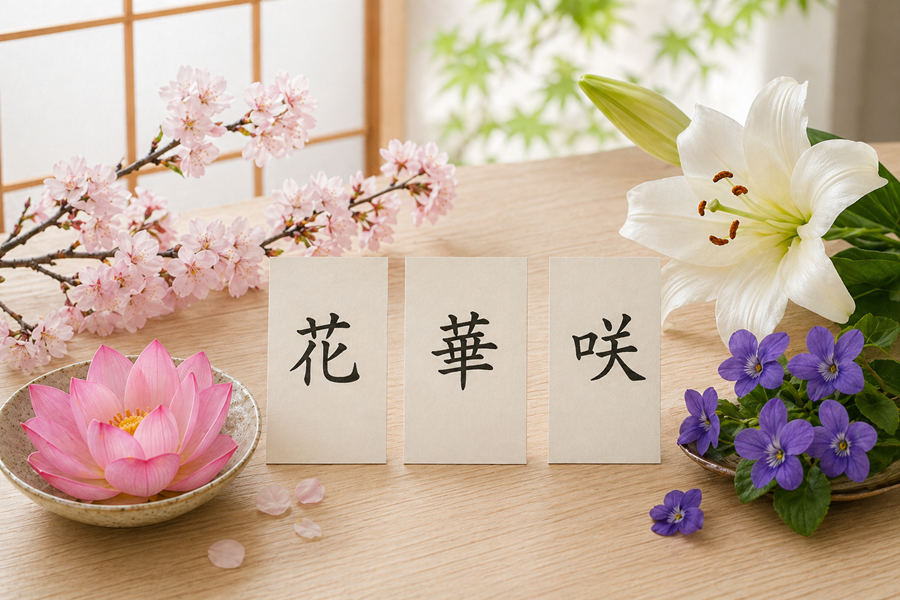
花 — Flower
花 is the clearest kanji for “flower.” It can be read as hana on its own and may appear as ka in name combinations. Names using 花 often feel simple, bright, and natural.
For example, Hana can mean “flower,” Hanako can mean “flower child,” and Ichika can mean “one flower” when written with the right kanji.
華 — Flower, Splendor, or Brilliance
華 can also connect to flowers, but it often has a more elegant or radiant feeling. Depending on the name, it may suggest floral beauty, splendor, grace, or brilliance.
This kanji is useful when you want a name that feels more refined than a simple nature name.
咲 — Bloom or Blossom
咲 means “to bloom” or “to blossom.” Names with this kanji do not usually mean “flower” as an object. Instead, they suggest the act of blooming.
Names such as Saki, Misaki, and Sakuya may use 咲. These names can feel hopeful, cheerful, and full of life.
Specific Flower Kanji
Some names are based on a particular flower rather than the general idea of flowers. These names can feel more vivid because each flower has its own season, color, and symbolism.
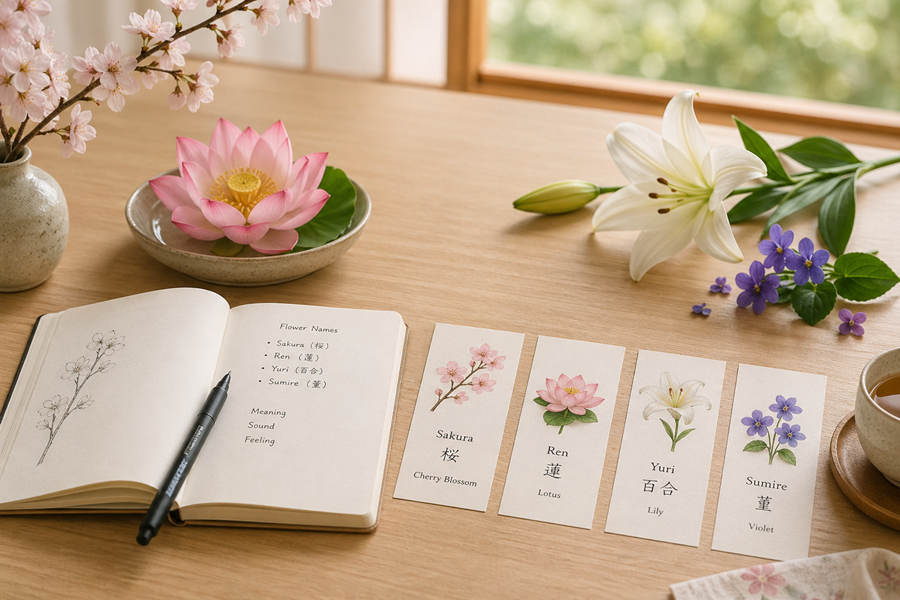
Examples include Sakura for cherry blossom, Ren for lotus, Yuri for lily, Sumire for violet, Ayame for iris, and Tsubaki for camellia.
Because Japanese names can have different kanji spellings, the meaning should always be checked by written form. The sound alone does not guarantee a flower meaning.
Japanese Names That Directly Mean Flower
These names are good starting points if you want the flower meaning to feel clear. Most include 花 or 華, though the exact meaning still depends on the full kanji spelling.
Hana
Hana means “flower” when written as 花. It is one of the simplest and most direct Japanese flower names. The sound is soft, easy to pronounce, and naturally graceful.
Hanako
Hanako can mean “flower child” when written with 花 for “flower” and 子 for “child.” It has a classic style and may feel more traditional than shorter names like Hana or Saki.
Ichika
Ichika can mean “one flower” when written as 一花. The image is simple and sweet, like a single special blossom. It feels modern, gentle, and memorable.
Kohana
Kohana can suggest “little flower” when written with 小 for “small” and 花 for “flower.” It has a tender, affectionate feeling and works well for a baby, pet, or gentle fictional character.
Kaho
Kaho can include 花 in some spellings. Depending on the second kanji, it may suggest a flower paired with beauty, fragrance, hope, or graceful movement. Since Kaho has many possible spellings, the floral meaning should be confirmed through the kanji.
Kanako
Kanako may be written with 花 or 華, giving it a connection to flowers, elegance, or brightness. When paired with 子, it has the familiar “child” ending found in many traditional Japanese girl names.
Kana
Kana can have many meanings, but floral spellings may include 花 or 華. With those kanji, the name can suggest flower-like beauty, grace, or brilliance.
Hanami
Hanami is also the Japanese word for flower viewing, especially cherry blossom viewing. As a name idea, it can feel seasonal and poetic, though it may be better for characters or creative naming than for everyday use.
Hanane
Hanane can suggest “flower sound” when written with 花 and a kanji such as 音 for “sound.” It feels delicate, lyrical, and uncommon.
Japanese Girl Names That Mean Flower
Flower names are especially common in girl-name lists because they can feel gentle, bright, graceful, and seasonal. Some directly include flower kanji, while others come from specific flowers.
Hana
Hana means “flower” when written as 花. It is one of the clearest Japanese girl names with a flower meaning.
Sakura
Sakura means “cherry blossom” when written as 桜. It is one of the most recognizable Japanese flower names and has a strong spring feeling.
Sumire
Sumire means “violet” when written as 菫. It has a quiet, graceful feeling and works well for readers who want a floral name that is soft but not overly obvious.
Yuri
Yuri means “lily” when written as 百合. It is short, elegant, and classic.
Ayame
Ayame is associated with the iris. It has a traditional, graceful nature image and can feel calm, refined, and poetic.
Tsubaki
Tsubaki means “camellia” when written as 椿. It feels richer and more dramatic than softer names like Hana or Sumire.
Saki
Saki can be written with 咲, meaning “bloom” or “blossom.” It has a cheerful, fresh sound and a clear floral connection.
Misaki
Misaki can include 美 for “beauty” and 咲 for “bloom.” With this spelling, it can suggest “beautiful bloom.”
Ichika
Ichika can mean “one flower” when written as 一花. It feels sweet, modern, and easy to remember.
Momoka
Momoka can mean “peach flower” when written with 桃 for “peach” and 花 for “flower.” It has a warm, springlike image.
Kanon
Kanon may be written with 花 for “flower” and 音 for “sound.” With this spelling, it can suggest “flower sound.”
Honoka
Honoka can be written in many ways. Some spellings include 花, giving the name a soft floral meaning. Without floral kanji, it should be treated as a gentle-sounding name rather than a direct flower name.
Rinka
Rinka can include 花 for “flower” or 華 for “splendor.” Depending on the kanji, it may suggest elegant floral beauty.
For the clearest girl names with flower meanings, Hana, Sakura, Sumire, Yuri, Ayame, Tsubaki, Saki, and Ichika are especially strong choices.
Japanese Boy Names That Mean Flower
Flower names are more often associated with girls, but some floral and plant-based names work beautifully for boys. The most natural choices tend to use stronger imagery, such as lotus, hollyhock, spring, trees, or fragrance.
Ren
Ren means “lotus” when written as 蓮. It is one of the strongest Japanese boy names with a clear flower meaning. The lotus image feels calm, dignified, and grounded.
Aoi
Aoi can mean “hollyhock” when written as 葵. It can also connect to blue-green color with different kanji. As a flower name, Aoi feels fresh, natural, and modern.
Saku
Saku can connect to blooming when written with 咲. It is short and clean in sound, making it feel less ornate than many floral names.
Sakuya
Sakuya can include 咲, giving it a blossom-related meaning. It has a poetic feeling and may work especially well for characters or creative naming.
Hanato
Hanato can be written with 花 for “flower” and another kanji chosen for the second part. It feels more modern and creative than classic names like Ren or Aoi, so the exact kanji should be chosen carefully.
Kaoru
Kaoru means “fragrance” or “to be fragrant” with kanji such as 薫. It does not directly mean flower, but it can carry a floral feeling because flowers are closely tied to scent. Kaoru can be used for different genders depending on context.
Haruki
Haruki does not directly mean flower in most spellings, but it can carry a springlike nature feeling when written with 春 for “spring.” It is best described as seasonal rather than directly floral.
Haruto
Haruto may also carry spring imagery when written with 春. It does not automatically mean flower, but it can suggest warmth, growth, and the season of blossoms.
Rento
Rento can begin with 蓮, meaning “lotus.” The second kanji shapes the full meaning. It feels more modern and stylized than the simpler Ren.
Renji
Renji can also begin with 蓮. The lotus connection gives the name a calm floral image, while the ending makes it feel firmer and more masculine.
For boy-friendly flower names, Ren and Aoi are the clearest options. Names like Saku, Sakuya, Hanato, Rento, and Renji can also work well when written with the right kanji.
Unisex Japanese Names With Flower Meanings
Some Japanese flower names feel flexible, especially for characters, pets, or creative naming. In real-life use, many names may lean feminine or masculine, but their sound and kanji can still make them appealing across different styles.
Ren
Ren means “lotus” when written as 蓮. It feels simple, strong, and elegant, making it one of the best unisex options with a flower meaning.
Aoi
Aoi can mean “hollyhock” with the kanji 葵. It feels fresh and natural, and it can work well in both realistic and fictional naming.
Saki
Saki can mean “bloom” or “blossom” when written with 咲. It often feels feminine, but the short sound can also work for characters or creative unisex names.
Kaoru
Kaoru means “fragrance” with kanji such as 薫. It is not a direct flower name, but it has a refined floral feeling.
Haru
Haru often means “spring” when written as 春. It is seasonal rather than directly floral, but it naturally suggests blossoms and new growth.
Koharu
Koharu can mean “little spring” when written with 小 and 春. It has a warm, gentle image that fits well with flower-name themes.
Rinka
Rinka can include 花 or 華, giving it a floral or elegant meaning. It often feels feminine, but it can work as a graceful character name.
Kazahana
Kazahana contains 花, but the word is also associated with light snow flurries. It feels poetic and is better suited to fiction or creative naming than everyday use.
For balanced unisex choices, Ren, Aoi, Kaoru, and Haru are the most natural. For a more obviously floral style, Saki, Rinka, and Kazahana bring the blossom image closer to the surface.
Japanese Names Inspired by Cherry Blossoms
Cherry blossom names are among the most loved Japanese flower names. The key kanji is 桜, which means “cherry blossom” or “cherry tree.” These names often feel graceful, springlike, and emotional.
Sakura
Sakura means “cherry blossom” when written as 桜. It is clear, recognizable, and strongly tied to spring.
Sakurako
Sakurako can mean “cherry blossom child” when written with 桜 and 子. It has a classic, elegant feeling.
Ouka
Ouka can mean “cherry blossom flower” when written as 桜花. It sounds more dramatic and formal than Sakura, so it works especially well for characters or creative names.
Sakuno
Sakuno can carry cherry blossom or bloom imagery depending on the kanji. It feels gentle, soft, and springlike.
Sakuya
Sakuya can include 咲, meaning “to bloom.” It does not always mean cherry blossom specifically, but it can carry a blossom-like feeling.
Sakumi
Sakumi can combine 咲 for “bloom” and 美 for “beauty,” giving it a meaning like “beautiful bloom.”
For a direct cherry blossom meaning, Sakura, Sakurako, and Ouka are the clearest choices. Names such as Sakuya and Sakumi are better described as blossom-inspired unless their kanji specifically include 桜.
Japanese Names Inspired by Lotus Flowers
Lotus names have a calm and graceful feeling. The main kanji is 蓮, which means “lotus” and is often read as ren in names. Compared with softer flower names, lotus names can feel stronger, quieter, and more grounded.
Ren
Ren means “lotus” when written as 蓮. It is short, strong, and easy to remember.
Renka
Renka can mean “lotus flower” when written with 蓮 and 花. It feels poetic and elegant.
Rena
Rena can begin with 蓮 for “lotus,” though the second kanji shapes the full meaning. With a floral spelling, it can feel soft and graceful.
Renji
Renji can include 蓮, giving it a lotus connection. It has a firmer sound than many flower names.
Rento
Rento can also begin with 蓮. Depending on the second kanji, it may suggest lotus paired with ideas such as personhood, flight, sound, or clarity.
Renya
Renya can use 蓮 for “lotus.” It has a smooth sound and can feel gentle while still carrying the strength of the lotus image.
Suiren
Suiren means “water lily” when written as 睡蓮. It is delicate, quiet, and poetic, making it especially useful for characters or creative naming.
For the clearest lotus meaning, Ren and Renka are the strongest choices. Names like Rena, Renji, Rento, and Renya can also carry a lotus meaning when written with 蓮.
Japanese Names Inspired by Specific Flowers
Specific flower names are helpful when you want a more detailed image than simply “flower.” A lily name feels different from a violet name, and a camellia name feels different from a cherry blossom name. The flower you choose can shape the whole mood of the name.
Lily Names
Yuri means “lily” when written as 百合. It is short, graceful, and classic.
Yuriko can mean “lily child” when written with 百合 and 子. It has a more traditional feeling than Yuri.
Sayuri can mean “small lily” when written as 小百合. It feels delicate and poetic.
Violet Names
Sumire means “violet” when written as 菫. It has a quiet, modest beauty.
Sumika is not automatically a violet name, but it can carry a floral or nature-inspired meaning with the right kanji.
Mirei is better understood as an elegant name that can be given a floral meaning through kanji, rather than a direct flower name by sound alone.
Iris Names
Ayame is commonly associated with iris. It feels traditional, graceful, and calm.
Ayaka can be written in many ways, including spellings that suggest color, fragrance, flower, or beauty. It should only be treated as floral when the kanji supports that meaning.
Shobu can refer to iris or Japanese iris, but it is much less common as a personal name. It is better for characters or symbolic naming.
Camellia Names
Tsubaki means “camellia” when written as 椿. It feels polished, rich, and memorable.
Akatsubaki can suggest “red camellia,” while Shiratsubaki can suggest “white camellia.” These are highly poetic and are better suited to fiction than everyday naming.
Plum and Peach Blossom Names
Ume means “plum” or “plum blossom” when written as 梅. It has an early-spring image and can suggest quiet strength.
Umeko can mean “plum child” when written with 梅 and 子. It has a traditional style.
Momo means “peach” when written as 桃. It can also carry a soft peach-blossom feeling.
Momoka can mean “peach flower” when written with 桃 and 花. It feels warm, sweet, and springlike.
Momoko can mean “peach child” when written with 桃 and 子.
Chrysanthemum Names
Kiku means “chrysanthemum” when written as 菊. It has a traditional and dignified feeling.
Kikuko can mean “chrysanthemum child” when written with 菊 and 子. It has an older, classic sound.
Kikka can mean “chrysanthemum flower” when written as 菊花. It feels crisp and elegant.
Other Flower-Inspired Names
Botan means “peony” when written as 牡丹. It has a lush, bold image.
Ran can mean “orchid” when written as 蘭. It is short, refined, and elegant.
Nazuna refers to shepherd’s purse, a small flowering plant. It feels gentle and natural.
Suiren means “water lily” when written as 睡蓮. It has a quiet, dreamy image.
Japanese Last Names That Mean Flower or Include Flower Kanji
Japanese surnames can also carry floral meanings, especially when they include kanji such as 花 for “flower,” 桜 for “cherry blossom,” 梅 for “plum,” or 菊 for “chrysanthemum.” Many flower-related surnames feel scenic because they connect flowers with fields, villages, rivers, wells, and other landscape features.
Hanada
Hanada can mean “flower field” or “flower rice field” when written with 花 and 田.
Hanamura
Hanamura can mean “flower village” when written with 花 and 村.
Hanazawa
Hanazawa can include 花 for “flower” and a landscape kanji such as 沢, often understood as a marsh, stream, or valley area.
Hanamoto
Hanamoto can mean “base of flowers” or “origin of flowers” when written with 花 and 本.
Hanafusa
Hanafusa can mean “flower cluster” or “bunch of flowers” when written with 花 and 房.
Sakurai
Sakurai often includes 桜 for “cherry blossom” and 井 for “well.” It can be understood as “cherry blossom well.”
Sakuraba
Sakuraba can suggest a cherry blossom place, field, or garden, depending on the kanji used for the second part.
Umezawa
Umezawa can include 梅 for “plum” and a landscape kanji such as 沢. It has an early-spring, plum-blossom feeling.
Kikuchi
Kikuchi may be written with 菊 for “chrysanthemum” and 池 for “pond.” With this spelling, it can be understood as “chrysanthemum pond.”
Kikukawa
Kikukawa can mean “chrysanthemum river” when written with 菊 and 川.
Flower-related Japanese last names are especially useful for characters because they create both a name and a setting. A surname such as Hanamura, Sakurai, or Umezawa can suggest a landscape, season, or family image without needing extra explanation.
Cute Japanese Flower Names for Babies
If you are choosing a flower name for a baby, the best options are usually clear, gentle, and natural in sound. Some names have a direct flower meaning, while others are connected to spring, blossoms, or a specific flower.
Hana
Hana is one of the sweetest and clearest choices. Written as 花, it means “flower.”
Sakura
Sakura means “cherry blossom.” It feels graceful, bright, and springlike.
Ichika
Ichika can mean “one flower.” It has a modern, light sound.
Sumire
Sumire means “violet.” It feels quiet, soft, and elegant.
Yuri
Yuri means “lily.” It is short, graceful, and easy to say.
Momoka
Momoka can mean “peach flower.” It has a warm, sweet image.
Kanon
Kanon can suggest “flower sound” with the right kanji. It feels melodic and modern.
Kaho
Kaho can include 花 in some spellings. It is short, pretty, and gentle.
Ren
Ren means “lotus.” It is simple, calm, and strong.
Aoi
Aoi can mean “hollyhock.” It feels fresh and natural.
Koharu
Koharu can mean “little spring.” It is not directly a flower name, but it carries the feeling of spring blossoms and warm new beginnings.
For real-life naming, Hana, Sakura, Sumire, Yuri, Ichika, Ren, and Aoi are especially strong options because their meanings are easier to understand and their sounds feel natural.
Elegant Japanese Flower Names for Characters
Flower names can work beautifully for fictional characters because they create an instant mood. A floral name can make a character feel gentle, mysterious, noble, cheerful, tragic, or otherworldly depending on the flower and kanji.
For characters, you have more room to use poetic names that may be uncommon in everyday life. The name should still match the character’s role, personality, and world.
Ouka
Ouka can mean “cherry blossom flower.” It feels refined, formal, and dramatic.
Renka
Renka can mean “lotus flower.” It suits a calm, wise, spiritual, or resilient character.
Hanatsuki
Hanatsuki can suggest “flower moon.” It feels dreamy and poetic, making it better for fiction than everyday use.
Tsukihana
Tsukihana can suggest “moon flower.” It has a quiet nighttime image and may suit a mysterious or magical character.
Kazahana
Kazahana contains a flower image but is also associated with light snow flurries. It can suggest beauty that appears briefly and disappears quickly.
Akihana
Akihana can mean “autumn flower.” It may suit a character connected to fall, memory, maturity, or quiet beauty.
Shirahana
Shirahana can suggest “white flower.” It has a pure, pale, graceful image.
Benihana
Benihana can mean “crimson flower.” It feels bold and striking.
Hanayuki
Hanayuki can suggest “flower snow.” It has a soft, cold, delicate image.
Ranko
Ranko can mean “orchid child” when written with 蘭 and 子. It has a vintage, elegant feeling.
Kikka
Kikka can mean “chrysanthemum flower.” It feels dignified and classical.
For realistic characters, names like Sakura, Hana, Ren, Aoi, Yuri, and Sumire may feel more natural. For fantasy, manga, games, or symbolic characters, names like Ouka, Renka, Hanatsuki, Tsukihana, and Hanayuki create a stronger visual effect.
Rare and Poetic Japanese Flower Names
Some Japanese flower names feel more literary, unusual, or symbolic than everyday choices. These names can be beautiful, but they need more care. A name that looks lovely in translation may sound uncommon, dramatic, old-fashioned, or better suited to fiction.
Botan
Botan means “peony.” It has a full, rich, elegant image.
Ran
Ran can mean “orchid.” It is short, refined, and graceful.
Ranko
Ranko can mean “orchid child.” It has a classic or vintage style.
Nazuna
Nazuna refers to shepherd’s purse, a small flowering plant. It feels humble, gentle, and natural.
Suiren
Suiren means “water lily.” It suggests stillness, reflection, and beauty on water.
Kaori
Kaori often means “fragrance.” It does not directly mean flower, but it has a natural floral feeling.
Yukihana
Yukihana can suggest “snow flower.” It is poetic and better for fiction or symbolic naming.
Tsukihana
Tsukihana can suggest “moon flower.” It feels dreamy, elegant, and mysterious.
Hanatsuki
Hanatsuki can suggest “flower moon.” It has a romantic, literary image.
Wakaba
Wakaba means “young leaves.” It is not a flower name, but it belongs naturally with spring and plant-inspired names.
Rare flower names can be beautiful for characters, stories, pets, games, or art projects. For a baby name, simpler and more familiar choices such as Hana, Sakura, Ren, Aoi, Yuri, and Sumire are usually easier to use.
How to Choose a Japanese Name That Means Flower
Choosing a Japanese flower name is easier when you start with the feeling you want the name to carry. Some names are simple and direct, like Hana. Others point to a specific bloom, like Sakura, Ren, Yuri, or Sumire. A few are more symbolic, using ideas like fragrance, spring, moonlight, snow, or blooming.
Start With the Exact Meaning
First, decide whether you want a name that directly means “flower” or a name inspired by a specific flower. For the clearest meaning, look for names with 花. For a more specific image, choose names such as Sakura for cherry blossom, Ren for lotus, Yuri for lily, Sumire for violet, Ayame for iris, or Tsubaki for camellia.
Check the Kanji
Japanese names often have several possible kanji spellings. A name like Kaho, Kanon, Rinka, or Haruka may have a flower meaning in one spelling and a completely different meaning in another. If the flower meaning matters, make sure the written form supports it.
Think About Real-Life Use
A name for a baby needs more care than a name for a pet, story, or game character. Some names, such as Hana, Sakura, Ren, Aoi, Yuri, and Sumire, feel more familiar as personal names. Others, such as Tsukihana, Hanatsuki, Yukihana, or Akatsubaki, are more poetic and may fit fiction better.
Match the Name to the Style You Want
Different flower names create different moods. Hana feels simple and gentle. Sakura feels bright and springlike. Ren feels calm and strong. Yuri feels elegant and classic. Tsubaki feels rich and dramatic. Sumire feels quiet and graceful.
Avoid Overly Literal Translations
It can be tempting to build a Japanese name by translating English words directly, such as “moon flower,” “white flower,” or “crimson blossom.” Some combinations can be beautiful, but not all of them sound natural as real Japanese names. For real-life naming, simpler choices are usually safer. For fiction, poetic names can work well when they match the story world.
Best Japanese Flower Names by Meaning
If you are comparing many names at once, this quick list can help you find the right style of flower name.
Names That Mean Flower
- Hana — flower
- Hanako — flower child
- Ichika — one flower
- Kohana — little flower
- Kanon — flower sound, depending on kanji
Names That Mean Bloom or Blossom
- Saki — bloom or blossom
- Misaki — beautiful bloom, depending on kanji
- Saku — bloom, depending on kanji
- Sakuya — blossom-related, depending on kanji
- Sakumi — beautiful bloom, depending on kanji
Names That Mean Cherry Blossom
- Sakura — cherry blossom
- Sakurako — cherry blossom child
- Ouka — cherry blossom flower
- Sakuno — cherry blossom or bloom imagery, depending on kanji
Names That Mean Lotus
- Ren — lotus
- Renka — lotus flower
- Rena — lotus-based, depending on kanji
- Renji — lotus-based, depending on kanji
- Suiren — water lily
Names That Mean Lily, Violet, Iris, or Camellia
- Yuri — lily
- Sayuri — small lily
- Sumire — violet
- Ayame — iris
- Tsubaki — camellia
Names That Mean Plum, Peach, Chrysanthemum, Orchid, or Peony
- Ume — plum or plum blossom
- Momoka — peach flower
- Kiku — chrysanthemum
- Ran — orchid
- Botan — peony
Final Thoughts
Japanese names that mean flower can be simple, elegant, seasonal, or deeply poetic. Some names, like Hana, give the meaning clearly through the kanji for “flower.” Others, like Sakura, Ren, Yuri, Sumire, and Tsubaki, point to a specific flower with its own image and feeling.
The best choice depends on how you want the name to sound and what kind of meaning you want it to carry. For a baby, a familiar and natural name may be best. For a character, pet, or creative project, a rarer name can add mood and symbolism. In every case, the kanji matters most. A beautiful Japanese flower name becomes much more meaningful when its sound, spelling, and image all bloom together.