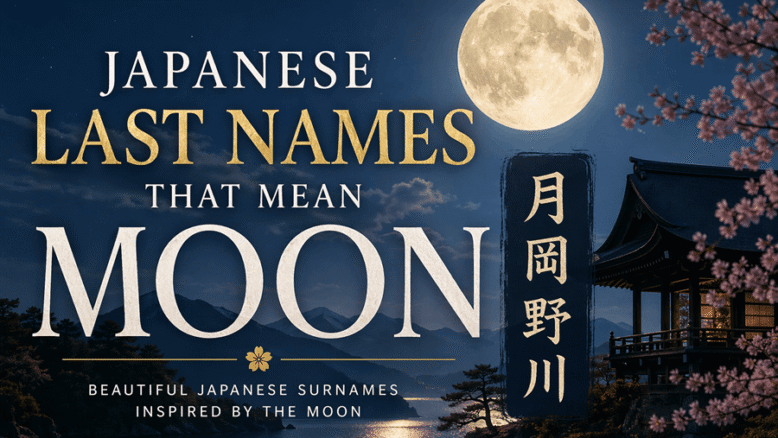
Japanese last names that mean moon have a special kind of beauty. Some use the kanji 月 directly, while others feel moon-related because they come from old place names, landscapes, or quiet natural imagery. That is what makes this topic so interesting. These surnames can feel elegant, calm, poetic, and rooted in real Japanese naming traditions at the same time.
One important thing to know is that Japanese surnames do not always work like modern English labels. A family name may look like it means “moon field” or “moon hill” on the surface, but its deeper history often comes from an actual village, region, or land feature. So when people look for Japanese last names that mean moon, the best approach is to look for real surnames that use 月 and carry a direct or very clear moon-related meaning through their kanji.
What Makes a Japanese Last Name Moon-Related?
A Japanese surname usually feels moon-related in one of three ways. First, it may include the kanji 月 directly. That is the clearest and strongest connection. Second, the surname may combine 月 with another landscape word such as field, hill, river, forest, or plain. Third, the name may come from an old place name where the moon kanji became part of a family identity over time.
That is why many of the best examples are not just “moon” by itself. Instead, they are names like moon field, moon hill, moon river, or moon forest. These feel natural as surnames because Japanese family names are often tied to geography and the land.
If you want to look more closely at the kanji itself, the character 月 is commonly read as tsuki when it stands for moon. A simple kanji reference like Kanshudo’s page for 月 can be helpful when you want to study the reading and nuance behind the character.
Japanese Last Names That Mean Moon
Below are some of the clearest real Japanese surnames that connect to the moon through the kanji 月. In some cases the meaning is very direct. In others, the name is best understood as a moon-related surname shaped by place-name history.
1. 月岡 (Tsukioka)
Literal feel: moon hill
This is one of the strongest examples because it sounds natural, elegant, and clearly uses the moon kanji. The second kanji, 岡, means hill or rise. Together, the name gives the image of a hill touched by moonlight. It feels refined and traditional, and it works very well if you want a surname that sounds real rather than invented.
2. 月野 (Tsukino)
Literal feel: moon field or moon plain
月野 is soft, open, and easy to remember. The kanji 野 often suggests a field, open plain, or uncultivated land. That gives this surname a wide, scenic feeling. It is one of the prettiest moon-related Japanese last names because it sounds both graceful and grounded.
3. 月田 (Tsukida / Tsukita)
Literal feel: moon rice field
This surname combines moon with 田, one of the most common land-based kanji in Japanese surnames. Because 田 refers to a rice field, the full name feels tied to the countryside and traditional rural landscapes. It has a calm and classic tone.
4. 月原 (Tsukihara / Tsukibara)
Literal feel: moon plain
原 suggests a broad plain, meadow, or open stretch of land. That makes 月原 feel spacious and poetic. It carries a slightly softer mood than some other examples and has a very visual quality, almost like a moonlit open field.
5. 月井 (Tsukii)
Literal feel: moon well
This is a compact and memorable surname. The kanji 井 means well, and in older naming patterns it often points to a place feature rather than a purely decorative image. Even so, the combination feels striking. It gives a quiet image, almost like moonlight reflected in water.
6. 月川 (Tsukikawa / Tsukigawa)
Literal feel: moon river
This is one of the most atmospheric choices on the list. The kanji 川 means river, so the full surname creates a very strong natural image. Even when the historical root is place-based, the modern feel of the name is undeniably poetic. For writers and readers, this is one of the most visually powerful moon-related surnames.
7. 月森 (Tsukimori)
Literal feel: moon forest
森 means forest, so this surname has a darker and deeper mood than names tied to plains or fields. It feels still, shaded, and mysterious. If you want a moon surname with a little more weight and atmosphere, this one stands out.
8. 月坂 (Tsukisaka / Tsukizaka)
Literal feel: moon slope
This is a beautiful surname with movement in it. The kanji 坂 means slope or hill road, so the name suggests a path, incline, or hillside under the moon. It has a poetic sound but still feels realistic as a family name.
9. 月本 (Tsukimoto)
Literal feel: moon origin or moon base
本 can suggest origin, root, or base. That gives this surname a slightly more abstract feel than some of the others. It is less visual than moon field or moon river, but it still has a clear moon connection and a clean, traditional sound.
10. 月輪 (Tsukinowa / Tsukiwa / Tsukiha)
Literal feel: moon ring or moon circle
This is one of the most unusual and elegant surnames in the group. The kanji 輪 means ring, wheel, or circle. Because of that, the full name has a polished and almost noble feeling. It also carries a more classical tone than many of the other examples.
11. 月島 (Tsukishima)
Literal feel: moon island
This is a rarer example, but it is easy to understand and very attractive in sound. The kanji 島 means island. The name feels scenic and memorable, though it is less common than stronger established examples like 月岡 or 月野.
12. 月谷 (Tsukitani)
Literal feel: moon valley
谷 means valley, which gives this surname a cool, quiet, shadowed feeling. It is a nice option if you like names that feel more secluded and atmospheric. It is also a good reminder that moon surnames often become most beautiful when paired with a landscape word.
The Meanings Behind Japanese Moon-Related Surnames
What makes these names appealing is not just the moon itself. It is the blend of moon imagery with natural land words. A surname like 月田 feels different from 月森. One feels open and agricultural. The other feels quiet and wooded. A name like 月川 feels flowing and reflective, while 月坂 feels like a path climbing into evening light.
That variety matters. It means you can choose a surname not only by literal meaning, but also by mood. Some feel bright and elegant. Some feel old and rural. Some feel rare and literary. That is part of the charm of Japanese surnames as a whole.
For broader background on how Japanese family names developed and why so many are tied to land, lineage, and older place associations, this overview from Nippon.com is a useful starting point.
How Japanese Surnames Get Their Meanings
Japanese surnames are often deeply connected to geography. Many of the best-known family names in Japan come from fields, bridges, forests, rivers, villages, and other local features. That is why moon-related surnames usually do not mean only “moon” in a simple standalone way. Instead, they often mean moon plus a terrain feature or moon plus a place-based root.
This is also why it is smart to be careful with name lists online. A pretty kanji combination is not automatically a real surname. Some combinations may sound lovely but have little evidence as actual family names. For this topic, the safest and strongest approach is to use real surnames that are already recorded and understood as part of Japanese naming tradition.
Are Japanese Last Names That Mean Moon Common or Rare?
Most moon-kanji surnames are on the uncommon side. That does not make them fake. It just means they are more distinctive than the biggest everyday surnames in Japan. Names like 月岡, 月野, 月田, and 月井 feel more established, while others such as 月島 or 月谷 are much rarer.
That balance can actually be a big advantage. You get a surname that feels authentic, but also memorable. For fiction, pen names, and character creation, that is often exactly what people want.
How to Choose a Japanese Last Name That Means Moon
If you are choosing one for a story, game, or character, start by asking what kind of mood you want.
If you want something soft and elegant, 月野 or 月岡 work well. If you want something deeper and more atmospheric, 月森 or 月谷 may fit better. If you want a surname with strong visual imagery, 月川 and 月坂 are excellent choices.
It also helps to decide whether you want a surname that feels more common, more literary, or more unusual. A grounded, believable name is often better than the most dramatic one. That is especially true for Japanese surnames, where subtlety usually feels more natural than something overly flashy.
Moon Symbolism in Japanese Culture
The moon has long carried a special place in Japanese culture. It is often linked with beauty, stillness, reflection, the passing seasons, and quiet emotion. That is one reason moon-related surnames feel so appealing. Even when a family name comes from a place name first, the moon kanji still carries strong emotional color.
If you want cultural background, Japan’s moon-viewing tradition, tsukimi, shows just how important moon imagery has been for centuries. Travel Japan has a helpful introduction to tsukimi and autumn moon viewing in Japan. Reading about that tradition adds useful depth to moon-themed naming topics because it shows that the moon is not just decorative. It is part of a wider seasonal and cultural imagination.
Final Thoughts on Japanese Last Names That Mean Moon
Japanese last names that mean moon are some of the most beautiful surnames to explore because they sit right at the meeting point of language, landscape, and tradition. Some have a direct and obvious moon meaning through the kanji 月. Others feel moon-related because they grew from old place names and natural terrain.
If you want the strongest choices, start with 月岡, 月野, 月田, 月原, and 月川. If you want something rarer or more atmospheric, look at 月森, 月坂, 月輪, or 月谷. Each one carries its own mood, and that is exactly what makes this category so rich.
In the end, the best Japanese moon surname is not always the rarest one. It is the one whose sound, meaning, and feeling all work together.