Some Japanese names feel as wide and quiet as the night sky. They may point directly to space through kanji like 宙, or they may carry a softer cosmic image through stars, moonlight, heaven, distance, or light. This guide explores Japanese names connected to galaxies, space, and the universe, with clear notes on which meanings are direct and which are more symbolic.
What “Galaxy,” “Space,” and “Universe” Mean in Japanese Names
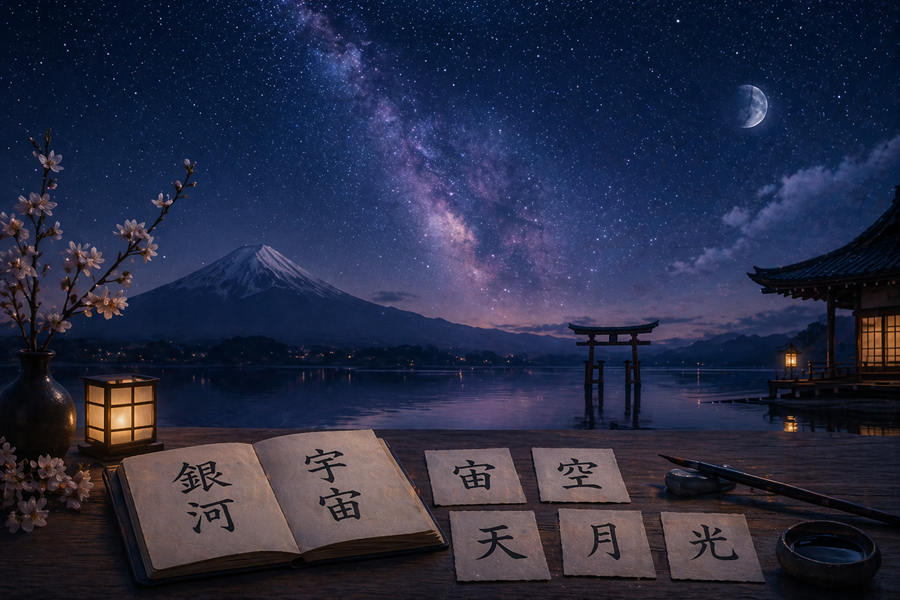
Japanese name meanings depend heavily on kanji. A romanized name may look simple, but the meaning can change completely depending on the characters used to write it. This is especially important with space-inspired names, because some names are directly connected to galaxies or stars, while others only suggest a cosmic feeling through sky, light, moon, heaven, or distance.
銀河, read ginga, means “galaxy” or “Milky Way.” It is one of the clearest Japanese words for a galaxy, but as a personal name it feels bold and uncommon. It may work beautifully for a character, pet, story, or creative project, but it is not as everyday as names like Sora, Hikari, or Subaru.
宇宙, read uchū, means “outer space” or “universe.” It is a common Japanese word, but it is not usually used as a typical given name. For a more natural space-related name, many people look for names that use 宙, which can suggest sky, air, or space.
宙 may be read as sora in names and can carry a modern, open, cosmic feeling. It does not always mean “the whole universe,” but it can suggest height, openness, and the vast space above.
空, also often read as sora, means “sky” or “open space.” Compared with 宙, it usually feels softer and more familiar. It brings to mind freedom, calmness, and a wide blue sky rather than deep outer space.
星, read hoshi or sometimes sei in names, means “star.” Many Japanese names with a cosmic feeling use this kanji because star meanings are often easier to include naturally in names than very literal words like “universe.”
天 means “heaven” or “sky,” while 月 means “moon” and 光 means “light.” These kanji do not mean galaxy or universe directly, but they fit naturally in a celestial name theme. They can suggest the heavens, moonlight, starlight, hope, brightness, or the quiet beauty of the night sky.
The key is to read the meaning through the kanji, not only through the sound. A name may feel celestial, but its meaning is only accurate when the written characters support that image.
Common Kanji Used in Japanese Space and Universe Names
Before choosing a Japanese name with a galaxy, space, or universe meaning, it helps to understand the kanji behind the name. These characters are the building blocks that create the name’s feeling.
星: Star
星 means “star.” It can be read as hoshi on its own and may appear as sei in some name combinations. This is one of the clearest kanji for a space-inspired name because the meaning is direct and easy to understand.
Names with 星 often feel bright, hopeful, and celestial. They may suggest a shining personality, a guiding light, or the beauty of the night sky.
宙: Space, Sky, or Air
宙 can mean sky, air, midair, or outer space depending on context. In names, it may be read as sora, giving the name a modern and expansive feeling.
A name using 宙 does not always mean “universe” literally, but it can strongly suggest space, openness, height, and the vast world above.
空: Sky or Open Space
空 means sky, empty space, or open air. It is often read as sora in names. Compared with 宙, this kanji can feel softer and more familiar.
For readers who want a name that feels open and celestial without sounding too unusual, 空 is one of the most natural choices.
天: Heaven or Sky
天 means heaven, sky, or the heavens. It does not directly mean outer space, but it belongs closely to celestial imagery. Names with 天 can feel graceful, elevated, spiritual, or noble.
月: Moon
月 means “moon.” It is read as tsuki on its own and may appear with other readings in name combinations. Moon-related names often feel quiet, elegant, and poetic.
光: Light
光 means “light.” It can be read as hikari on its own and may appear as kō in some names. This kanji can suggest brightness, hope, clarity, guidance, or starlight.
銀: Silver
銀 means “silver.” By itself, it does not mean galaxy, but it appears in 銀河, meaning “galaxy” or “Milky Way.” It can give a name a cool, shining, night-sky feeling.
河: River
河 means “river.” In 銀河, it helps create the image of a “silver river,” which is how the Milky Way is expressed in Japanese. On its own, 河 is a river kanji, so it should not be treated as a galaxy meaning unless it appears in the right combination.
永: Eternal
永 means eternal, long-lasting, or forever. It is not a space kanji, but it can support a universe-like feeling because the cosmos is often associated with time, vastness, and endurance.
遥 / 遙: Faraway or Distant
遥, also written in the older form 遙, means faraway or distant. It does not mean space directly, but it can pair well with a cosmic theme because galaxies and stars often carry the feeling of faraway light.
Japanese Names That Directly Mean Space, Sky, or Universe
Names that directly suggest space or the universe often use kanji like 宙, 空, or 天. These characters can point to the sky, open air, heaven, or outer space. Still, a name may feel cosmic without literally meaning “the universe.”
The direct Japanese word for “universe” or “outer space” is 宇宙, read uchū. It is a real word, but it is usually not an everyday given name. For a more natural name, many people choose names that include 宙 or 空 because they keep the wide, sky-like feeling while sounding more name-like.
Sora
Sora is one of the clearest Japanese names connected to sky and space. It can be written as 空, meaning “sky” or “open space,” or as 宙, which can suggest “sky,” “air,” or “space.”
With 空, Sora feels peaceful, free, and open, like a clear sky. With 宙, it feels more modern and cosmic, closer to the idea of outer space.
Sorato
Sorato is a modern-sounding name that can include 空 or 宙, depending on the kanji chosen. Because of that, it can carry a sky or space association while still feeling more like a given name than a literal word such as Uchū.
The second kanji changes the full meaning, so Sorato should always be explained through its exact written form.
Hiroto
Hiroto can be written in many ways. Some forms may use 宙, giving the name a spacious or sky-related feeling. Other forms use completely different kanji, so Hiroto should not always be translated as a space name.
When written with 宙, it can suggest something wide, open, and expansive.
Kanata
Kanata is often associated with “beyond,” “far away,” or “the distance.” It does not directly mean galaxy or universe, but it fits a space-themed list because it suggests something far across the sky or beyond the horizon.
For a character, Kanata may bring to mind distant stars, a faraway world, or a journey into the unknown. For real-life naming, the exact kanji should be checked carefully.
Tenma
Tenma can include 天, meaning “heaven” or “sky.” This gives the name a high, celestial feeling, though it does not literally mean outer space.
Depending on the full kanji, Tenma can sound strong, bright, spiritual, or noble.
Amane
Amane can be connected with 天 in some kanji forms. The sound is gentle, and the name can feel graceful, airy, or heavenly depending on how it is written.
Amane may not mean space directly, but when written with sky or heaven-related kanji, it belongs naturally in a celestial name theme.
Uchū
Uchū, written 宇宙, means “outer space” or “universe.” It is the most direct Japanese word for the idea, but it is usually a common noun rather than a typical personal name.
For that reason, Uchū may work better for a fictional character, pet, story title, game name, or creative project than for a real baby name.
Japanese Names That Mean Galaxy or Milky Way
The most direct Japanese word for “galaxy” is 銀河, read ginga. It can also refer to the Milky Way depending on context. The kanji are beautiful: 銀 means “silver,” and 河 means “river.” Together, they create the image of a silver river across the night sky.
Because Ginga is so direct, it has a bold and memorable sound. It may appeal to readers who want a name that clearly means galaxy, but it is less everyday than names such as Sora, Hikari, or Subaru.
Ginga
Ginga, written 銀河, means “galaxy” or “Milky Way.” This is the clearest choice if you want a Japanese name or name idea that directly carries the meaning of a galaxy.
Ginga feels grand, bright, and cosmic. Because it is also a regular Japanese word, it may sound more like a poetic or character-style name than a common personal name.
Gin
Gin, written 銀, means “silver.” By itself, it does not mean galaxy. However, it is the first kanji in 銀河, so it can carry a cool, shining, night-sky image.
Gin is short, strong, and simple. It may suit a character name, especially one with a calm, mysterious, moonlit, or starry quality.
Gingetsu
Gingetsu can be written as 銀月, meaning “silver moon.” This is not a common everyday given name, but it has a clear poetic meaning.
Gingetsu is best for fiction, fantasy, poetry, pets, or creative projects. It does not mean galaxy, but it fits naturally beside galaxy names because it uses the same silver night-sky imagery found in 銀河.
Ginsei
Ginsei can be written as 銀星, meaning “silver star.” This is more creative than ordinary, but it has a clear celestial feeling.
Because 星 means “star,” Ginsei feels closer to space imagery than many purely poetic names. Still, it should be described as a creative name idea rather than a common traditional name.
Seiga
Seiga can have different meanings depending on the kanji. A creative form might use 星, the kanji for “star,” but the name does not automatically mean galaxy or space unless the chosen characters support that meaning.
Seiga can sound refined and celestial, but its meaning should never be guessed from sound alone.
Japanese Names That Mean Star or Have Star Meanings
Star names are some of the most natural choices for a Japanese space-inspired name. Names that directly mean “universe” can sound very literal, while names connected to 星 often feel brighter, softer, and easier to use.
Some star names are direct, like Hoshi. Others depend on the kanji combination. A name only has a star meaning if it is written with star-related kanji such as 星, 昴, or 流星.
Hoshi
Hoshi, written 星, means “star.” It is simple, clear, and directly connected to the night sky.
As a name, Hoshi has a bright and gentle feeling, though it can also feel more word-like than some longer given names. It works especially well for characters, pets, and symbolic name ideas.
Hoshiko
Hoshiko can be written 星子, meaning “star child.” The kanji 星 means “star,” and 子 means “child.”
Because names ending in -ko were especially common in earlier generations, Hoshiko may feel classic or vintage rather than modern. It is still a clear and lovely choice for a star-themed name list.
Seina
Seina may be written with 星 in some kanji combinations, giving it a star-related meaning. The full meaning depends on the second character, so Seina should not always be translated as “star” unless the kanji includes 星.
When written with star kanji, Seina feels bright, graceful, and modern.
Seiya
Seiya can also include 星, giving the name a starry or celestial feeling. Depending on the second kanji, it may suggest brightness, night, strength, or elegance.
This name is often a good fit for boy-name lists because it has a strong yet polished sound.
Subaru
Subaru, written 昴, refers to the Pleiades star cluster. This makes it one of the most meaningful Japanese names for readers who want a real celestial connection rather than a loose space association.
Subaru feels bright, distinctive, and elegant. It is more name-like than very literal words such as Uchū, while still carrying a true astronomical meaning.
Ryūsei
Ryūsei, written 流星, means “shooting star” or “meteor.” The kanji 流 means “flow” or “stream,” while 星 means “star.” Together, they create the image of a star moving across the sky.
Ryūsei has an energetic and dramatic feeling. It works especially well as a boy name or character name.
Kōsei
Kōsei can be written in many ways. Some forms may include 星, giving a star-related meaning, while others may include 光, meaning “light.”
A Kōsei written with star or light kanji can fit a cosmic theme. Without those kanji, it should not be treated as a space name.
Nanase
Nanase can be connected to stars in creative kanji forms such as 七星, which can mean “seven stars.” The name has many other possible spellings, so the star meaning depends on the written form.
Nanase can be beautiful in a space-inspired list, as long as the kanji connection is clear.
Japanese Girl Names Inspired by Galaxy, Space, or the Universe
Girl names with a galaxy or universe feeling often lean toward softer celestial images: stars, moonlight, clear skies, gentle brightness, and the quiet beauty of night. Some names below have direct sky or star meanings, while others depend on the kanji chosen.
Sora
Sora can be written as 空, meaning “sky” or “open space,” or 宙, which can suggest “sky,” “air,” or “space.”
As a girl name, Sora feels clear, free, and peaceful. With 宙, it has a more space-like feeling. With 空, it feels closer to the open blue sky.
Hikari
Hikari, written 光, means “light.” It does not mean galaxy or universe directly, but it fits beautifully with space-inspired names because stars, moons, and galaxies are all connected with light.
Hikari feels bright, hopeful, and warm.
Akari
Akari can mean “light” or “brightness” depending on the kanji. In a cosmic name theme, Akari can suggest a small light in the dark, like a star, lantern, or moonlit window.
Hoshiko
Hoshiko, written 星子, means “star child.” It has a sweet, vintage feeling because many girl names ending in -ko sound more traditional today.
Seina
Seina may include 星, the kanji for “star,” in some spellings. When written this way, it can carry a bright, celestial meaning.
Other kanji forms may have completely different meanings, so the spelling matters.
Tsukiko
Tsukiko, written 月子, means “moon child.” It is not a galaxy name, but it fits naturally into a universe-inspired guide because the moon is one of the most familiar lights in the night sky.
Mitsuki
Mitsuki can have several meanings depending on the kanji. Some forms may include 月, meaning “moon,” while others may include characters connected to beauty, light, or fullness.
When written with 月, Mitsuki can carry a lovely night-sky feeling.
Amane
Amane can be written with kanji connected to heaven or sky, such as 天, depending on the chosen form. It does not automatically mean space, but it can have a soft celestial feeling when the kanji supports it.
Runa
Runa is often loved because it sounds close to “luna.” In Japanese, however, its meaning depends completely on the kanji or kana spelling. It should not be translated as “moon” unless the chosen characters support that idea.
Mio
Mio is a gentle Japanese girl name with many possible kanji forms. It is not automatically a space or galaxy name, but some creative spellings may give it a soft beauty, light, or water-like image that pairs well with celestial themes.
For girl names, the most direct cosmic choices in this group are Sora, Hoshiko, and star-related forms of Seina. Names like Hikari, Akari, Tsukiko, Mitsuki, and Amane bring in related images of light, moon, heaven, and the night sky.
Japanese Boy Names Inspired by Galaxy, Space, or the Universe
Boy names with a space or universe feeling often use strong images: stars moving across the sky, broad open space, heavenly height, light, and distance. Some names below have direct celestial meanings, while others become space-related only when written with the right kanji.
Sora
Sora can be written as 空, meaning “sky” or “open space,” or 宙, which can suggest “sky,” “air,” or “space.”
As a boy name, Sora feels fresh, open, and bright. With 宙, it leans more cosmic. With 空, it feels more like the wide sky and freedom.
Subaru
Subaru, written 昴, refers to the Pleiades star cluster. This gives it a direct and meaningful connection to the night sky.
Ryūsei
Ryūsei, written 流星, means “shooting star” or “meteor.” The image is active and bright, like a star-like light moving quickly across the night sky.
This name can suggest speed, brilliance, ambition, or a life that shines strongly.
Seiya
Seiya can include 星, the kanji for “star,” depending on the chosen spelling. When written with star-related kanji, it can carry a clear celestial feeling.
Hiroto
Hiroto can be written in many ways. Some kanji forms may include 宙, giving the name a wide sky, air, or space association.
Without that kanji, Hiroto may have a completely different meaning, so this name is best explained as kanji-dependent.
Kanata
Kanata is often associated with “far away,” “beyond,” or a distant place. It does not literally mean galaxy or universe, but it fits the feeling of space because it suggests distance, horizon, and something far across the sky.
Tenma
Tenma can include 天, meaning “heaven” or “sky.” This gives the name a high, celestial feeling, though it does not directly mean outer space.
Kōki
Kōki can be written with many kanji combinations. Some forms may include 光, meaning “light,” or other characters connected to brightness and radiance.
When written with light-related kanji, Kōki can suggest a shining presence, like starlight or sunlight.
Haruto
Haruto is a popular style of Japanese boy name with many possible kanji forms. Some spellings can suggest sunlight, spring, brightness, or open sky, while others may have unrelated meanings.
Haruto should not be treated as a direct space name unless the kanji supports the connection.
Sorato
Sorato can include 空 or 宙, giving it a sky or space association. The ending kanji changes the full meaning, so the name can feel different depending on how it is written.
For boy names, the strongest direct cosmic choices are Sora, Subaru, and Ryūsei. Names like Hiroto, Seiya, Tenma, Kōki, and Haruto can also fit beautifully when their kanji support a sky, star, light, or heavenly meaning.
Unisex Japanese Names With Space, Sky, and Star Meanings
Some Japanese names feel flexible enough for different genders, especially when they are short, nature-based, or built around clear images like sky, light, stars, and distance. These names can work well for babies, characters, pets, or creative projects, but the meaning still depends on the kanji.
Sora
Sora is one of the strongest unisex choices for this theme. Written as 空, it means “sky” or “open space.” Written as 宙, it can suggest “sky,” “air,” or “space.”
Hikari
Hikari, written 光, means “light.” It is not a direct galaxy or universe name, but it fits a cosmic theme because stars, moons, and galaxies are all seen through light.
Kanata
Kanata is often connected with the idea of “far away,” “beyond,” or a distant place. It can suggest a horizon, a distant star, or a world beyond what the eye can see.
Subaru
Subaru, written 昴, refers to the Pleiades star cluster. It is often used as a boy name, but it can also feel flexible in creative contexts because its meaning is tied to a star cluster rather than a gendered image.
Akari
Akari can mean “light” or “brightness” depending on the kanji. In a galaxy or universe theme, it can suggest a small glow in darkness, like starlight, moonlight, or a lamp seen under the night sky.
Amane
Amane can be connected to heaven or sky depending on its kanji, including forms that use 天. It feels airy, calm, and refined when the written form supports that image.
Rui
Rui is a soft, short name that can be used with many kanji combinations. It is not automatically a space name, but it may work in a cosmic-themed list if the chosen kanji gives it a bright, elegant, or jewel-like feeling.
Noa
Noa is a modern-sounding name with several possible kanji choices. It does not naturally mean galaxy, space, or universe on its own, but some creative spellings may give it a soft sky, hope, or light-related feeling.
For unisex names, Sora, Hikari, Kanata, and Subaru are the strongest choices in this theme. Names like Akari, Amane, Rui, and Noa can also fit when the kanji or overall feeling points toward light, sky, heaven, or cosmic beauty.
Rare and Unique Japanese Space-Inspired Names
Some space-inspired Japanese names are beautiful because they feel unusual, dramatic, or poetic. These names may not be common everyday choices, but they can work well for characters, pets, pen names, game names, stories, or creative projects.
For real-life baby naming, it is especially important to check the kanji, pronunciation, and naturalness with a fluent Japanese speaker.
Ginga
Ginga, written 銀河, means “galaxy” or “Milky Way.” It is one of the most direct choices in this guide, but it also feels bold because it is a common word as well as a possible name idea.
Uchū
Uchū, written 宇宙, means “universe” or “outer space.” The meaning is direct and easy to understand, but it is usually used as a regular Japanese word rather than a typical given name.
Uchū can still be powerful for fiction, fantasy, science-fiction worlds, art projects, or symbolic naming.
Hoshizora
Hoshizora, written 星空, means “starry sky.” The meaning is beautiful and clear: 星 means “star,” and 空 means “sky.”
Hoshizora sounds dreamy and romantic, but it is more like a phrase than a common given name.
Amatsuki
Amatsuki can suggest a “heavenly moon” feeling when connected with kanji such as 天 for heaven or sky and 月 for moon. The exact meaning depends on the written form.
This name idea feels elegant, old-world, and slightly mythical. It may be better suited to fiction, fantasy, or poetic naming than to ordinary daily use.
Gingetsu
Gingetsu, written 銀月, can mean “silver moon.” It does not mean galaxy, but it shares the silver night-sky image found in 銀河.
Seiran
Seiran can have different meanings depending on the kanji. In a space-inspired context, it may be styled with star-related or sky-related characters, but it should not be assumed to mean galaxy or universe by sound alone.
Raito
Raito is a modern-sounding name often associated with the English word “light.” In Japanese, however, the actual meaning depends on kanji or kana spelling. It should not automatically be translated as “light” unless the written form supports it.
Sorane
Sorane can be a creative name idea using 空 or 宙 for sora, giving it a sky or space connection. The second part of the name changes the final meaning.
Rare space-inspired names can be very appealing, but they need careful explanation. Names like Ginga, Uchū, and Hoshizora have clear meanings, while names like Seiran, Raito, and Sorane depend strongly on the kanji.
Japanese Names Connected to the Moon, Night Sky, and Cosmic Light
Not every cosmic Japanese name needs to use the word “galaxy” or “universe.” Some of the most natural options come from softer images: moonlight, starlight, fireflies, night skies, and quiet brightness.
Tsuki
Tsuki, written 月, means “moon.” It is clear, simple, and closely tied to the night sky.
Tsukiko
Tsukiko, written 月子, means “moon child.” The kanji 月 means “moon,” and 子 means “child.”
Tsukiko has a classic, gentle sound. Like many names ending in -ko, it may feel more traditional or vintage today.
Mitsuki
Mitsuki can have several meanings depending on the kanji. Some forms include 月, giving the name a moon connection. Others may use kanji for beauty, fullness, hope, or light.
Runa
Runa is often associated with a moon-like feeling because it sounds close to “luna.” In Japanese, though, the meaning depends on the chosen kanji or kana spelling.
Mizuki
Mizuki has many possible kanji forms. Some may include 月, which gives it a moon-related meaning, while others use kanji connected to beauty, water, trees, or freshness.
Mizuki can fit a cosmic theme when the spelling includes moon imagery, but it is not automatically a space name.
Hikari
Hikari, written 光, means “light.” It can suggest sunlight, starlight, moonlight, or a guiding glow, depending on the feeling of the name.
Akari
Akari can mean “light,” “brightness,” or a gentle glow depending on the kanji. In a universe-inspired name list, it can suggest a small light in darkness.
Kōki
Kōki can be written with many kanji combinations. Some forms include 光, meaning “light,” or other characters related to brightness and radiance.
Teru
Teru can be connected to kanji such as 照, meaning “to shine” or “to illuminate.” It is not a galaxy or space name by itself, but it can suggest the act of shining like light from the sun, moon, or stars.
Hotaru
Hotaru, written 蛍, means “firefly.” It is not a space name, but it has a soft night-light image that pairs beautifully with moon, star, and evening themes.
Yozora
Yozora, written 夜空, means “night sky.” The kanji 夜 means “night,” and 空 means “sky.”
Yozora is beautiful and clear, but it is more like a phrase than a common everyday given name. It may work best for characters, pets, titles, or creative projects.
Japanese Last Names With Sky, Star, Moon, or Universe Imagery
Japanese surnames often come from places, landscapes, fields, rivers, villages, mountains, and natural features. Because of that, many last names have beautiful images built into the kanji. A surname may not have been “chosen” for a cosmic meaning in the same way a given name might be, but it can still carry a poetic sky, star, or moon feeling.
Hoshino
Hoshino, written 星野, can be understood as “star field.” The kanji 星 means “star,” and 野 means “field” or “plain.”
This is one of the clearest Japanese surnames for a celestial theme.
Tsukino
Tsukino, written 月野, can mean “moon field.” The kanji 月 means “moon,” while 野 means “field” or “plain.”
Amano
Amano, often written 天野, can be read as “heavenly field” or “sky field.” The kanji 天 means “heaven” or “sky,” and 野 means “field.”
This surname does not mean outer space, but it has a clear skyward feeling.
Sorano
Sorano, written 空野, can mean “sky field.” The kanji 空 means “sky” or “open space,” while 野 means “field.”
Hoshikawa
Hoshikawa, written 星川, can mean “star river.” The kanji 星 means “star,” and 川 means “river.”
This surname has a strong celestial image and may remind readers of stars flowing across the night sky.
Amemiya
Amemiya, often written 雨宮, can mean “rain shrine.” The kanji 雨 means “rain,” and 宮 means “shrine” or “palace.”
Amemiya is not a space or universe surname, but it has sky and weather imagery. It should be described as sky-adjacent rather than truly space-related.
Tsukishima
Tsukishima, written 月島, can mean “moon island.” The kanji 月 means “moon,” and 島 means “island.”
Japanese last names can add a beautiful landscape feeling to a cosmic name list. Hoshino, Tsukino, Amano, and Hoshikawa are especially strong choices for star, moon, and heaven imagery.
Names Best for Babies vs. Characters, Pets, and Fiction
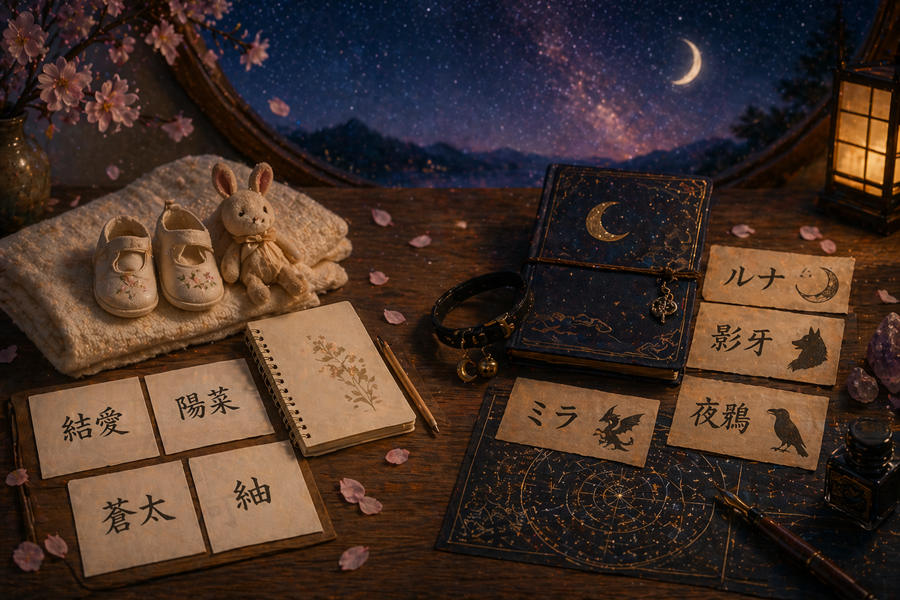
Some Japanese cosmic names feel natural enough for everyday use. Others are beautiful but more dramatic, literal, or phrase-like, which can make them better for characters, pets, pen names, stories, games, or creative projects.
This difference matters because a name like Sora can feel simple and name-like, while a word like Uchū clearly means “universe” but may sound too literal as a real personal name.
Names That May Work Well for Real-Life Naming
Sora is one of the most natural choices for a space or sky meaning. Written as 空, it means “sky” or “open space.” Written as 宙, it can suggest “sky,” “air,” or “space.”
Hikari, written 光, means “light.” It has a bright and hopeful feeling that fits well with stars, moonlight, and the wider sky.
Akari can mean “light” or “brightness” depending on the kanji. It feels gentle and familiar, making it a softer option for readers who want celestial imagery without choosing a very unusual name.
Subaru, written 昴, refers to the Pleiades star cluster. It has a real astronomical meaning while still feeling like a usable name.
Ryūsei, written 流星, means “shooting star” or “meteor.” It has a strong, energetic sound and a clear star-related meaning.
Kanata suggests “far away” or “beyond,” depending on the kanji and context. It does not directly mean space, but it brings to mind distance, horizons, and faraway stars.
Amane can feel heavenly or sky-related when written with suitable kanji such as 天. It is softer and less direct than Ginga or Uchū.
Kōki can carry a bright or radiant meaning when written with light-related kanji such as 光. Because it has many possible spellings, the kanji must be checked before calling it a light or cosmic name.
Names Better for Characters, Pets, or Creative Projects
Ginga, written 銀河, means “galaxy” or “Milky Way.” The meaning is beautiful and direct, but because it is also a regular word, it can feel bold or character-like as a personal name.
Uchū, written 宇宙, means “universe” or “outer space.” It is powerful and clear, but it is usually used as a common noun rather than a normal given name.
Hoshizora, written 星空, means “starry sky.” It is lovely and easy to understand, but it sounds more like a phrase than an everyday given name.
Gingetsu, written 銀月, can mean “silver moon.” It has a poetic night-sky image, but it feels more creative than ordinary.
Amatsuki can suggest a heavenly moon feeling when written with kanji such as 天 and 月. It sounds elegant and dramatic, which may suit fantasy, fiction, or symbolic naming.
Ginsei, written creatively as 銀星, can mean “silver star.” It is clear and celestial, but it is better described as a creative name idea than a common real-life name.
Yozora, written 夜空, means “night sky.” Like Hoshizora, it has a beautiful meaning but feels more like a phrase than a typical personal name.
How to Choose a Japanese Name With a Cosmic Meaning
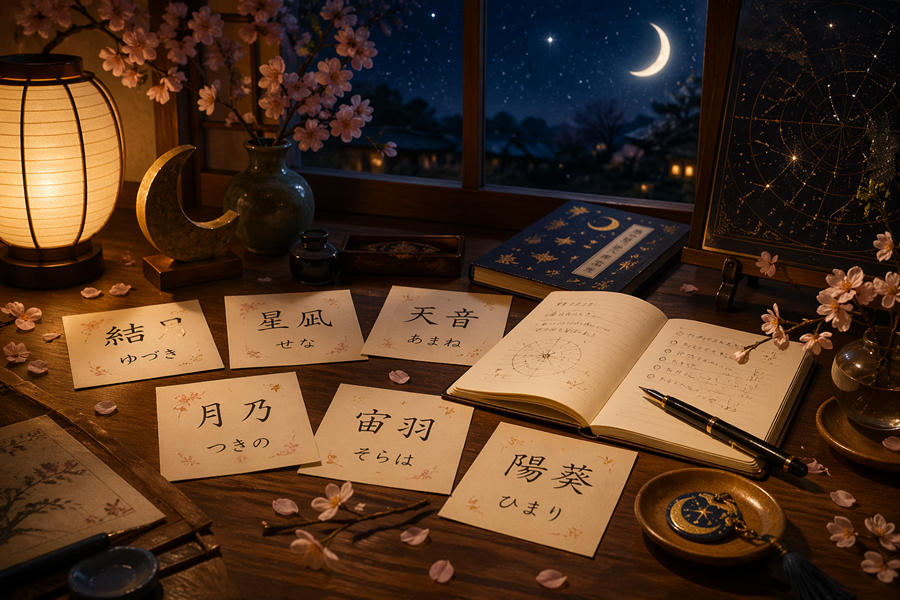
Choosing a Japanese name connected to galaxies, space, or the universe is not only about finding a beautiful sound. The meaning depends on the kanji, and the same reading can change completely when written with different characters. A careful choice will feel clearer, more respectful, and more accurate.
Check the Kanji First
Romanized spellings can be misleading. A name like Sora may be written as 空, meaning “sky,” or 宙, which can suggest “space,” “sky,” or “air.” A name like Seiya may include 星, meaning “star,” but it can also be written with other kanji that do not have a star meaning.
Before using a name, look at the exact kanji. That is where the meaning comes from.
Decide Between Direct and Symbolic Meanings
Some names are direct. Ginga, written 銀河, means “galaxy” or “Milky Way.” Ryūsei, written 流星, means “shooting star.” These names clearly show their cosmic meaning.
Other names are symbolic. Hikari means “light,” while Kanata can suggest something far away or beyond. They do not mean universe, but they can still feel cosmic because they connect to starlight, distance, and the sky.
Avoid Overstretching the Meaning
A name should not be called a “universe name” just because it sounds dreamy. For example, Runa may feel moon-like because it sounds close to “luna,” but its Japanese meaning depends on the kanji. Noa may feel modern and soft, but it is not automatically connected to space.
If the kanji does not show a galaxy, star, moon, sky, heaven, light, or distance meaning, describe the name as symbolic or creative instead of direct.
Think About Naturalness
Some cosmic words are beautiful but may feel too literal as real personal names. Uchū, written 宇宙, means “universe” or “outer space,” but it is usually a common word rather than an everyday given name. Hoshizora, written 星空, means “starry sky,” but it sounds more like a phrase.
For babies, names like Sora, Hikari, Akari, Subaru, and Kanata may feel easier to use. For stories, games, pets, or fantasy characters, bold choices like Ginga, Uchū, and Yozora may work beautifully.
Consider Sound, Reading, and Balance
A good name should sound natural when spoken and look balanced when written. Some kanji may have a lovely meaning but an unusual reading. Others may be readable but feel too heavy, too literal, or too poetic for daily use.
This is especially important with creative names. A combination like 銀星 for Ginsei can suggest “silver star,” but it may feel more like a created name than a familiar given name.
Ask a Fluent Japanese Speaker for Baby Naming
If the name is for a real child, it is best to check it with a fluent Japanese speaker or a reliable Japanese naming source. They can help you understand whether the kanji are readable, whether the name feels natural, and whether there are any awkward impressions you might miss.
For fiction or creative projects, you can be more flexible. Still, checking the kanji will help the name feel more intentional and believable.
Conclusion
Japanese names connected to galaxies, space, and the universe can be direct, symbolic, or creative. A name like Ginga clearly points to a galaxy, while Sora can suggest the sky or space depending on whether it is written as 空 or 宙. Names such as Subaru, Ryūsei, Hikari, and Tsukiko bring in related images of stars, shooting stars, light, and the moon.
The most important thing is to look at the kanji. Japanese name meanings do not come from the romanized spelling alone. The same sound can have several different meanings, and a beautiful cosmic feeling only becomes accurate when the written characters support it.
A good cosmic Japanese name does not always need to mean “universe” word for word. Sometimes the most beautiful choice is a name that suggests a star, a faraway sky, a quiet moon, or a small light shining in the dark.